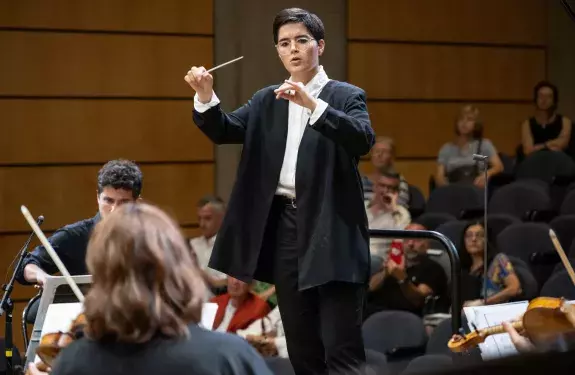
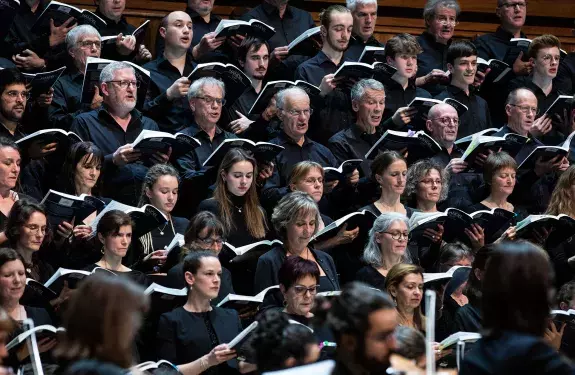
Maestro al Cembalo Performance and Baroque Ensemble Conducting

Teachers

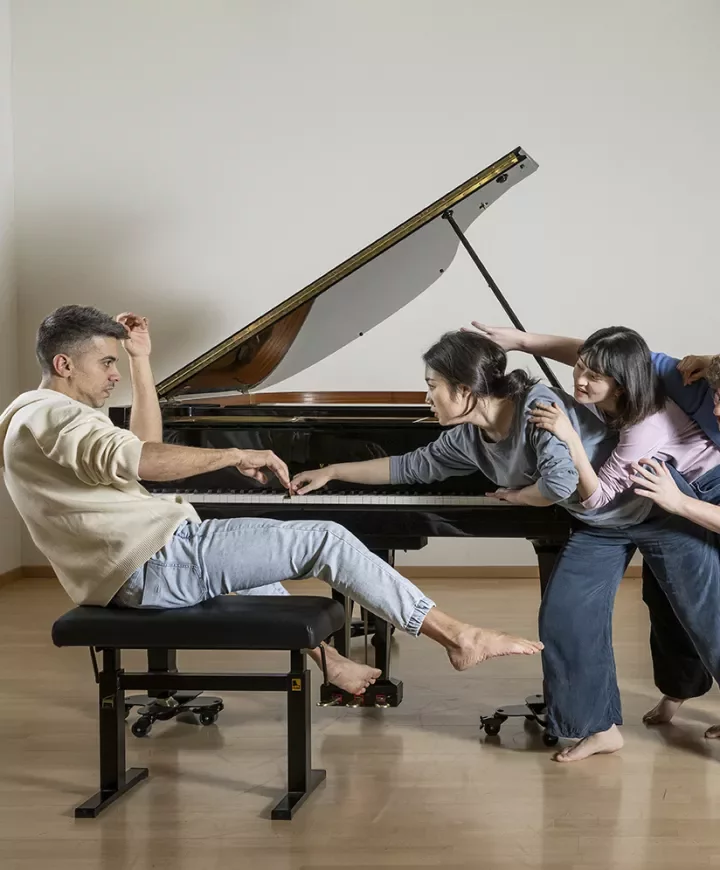
Leonardo Garcia Alarcon

Professor of Maestro al Cembalo - Professor of Elements of Choral Conducting (for Maestro al Cembalo) - Madrigal Ensemble

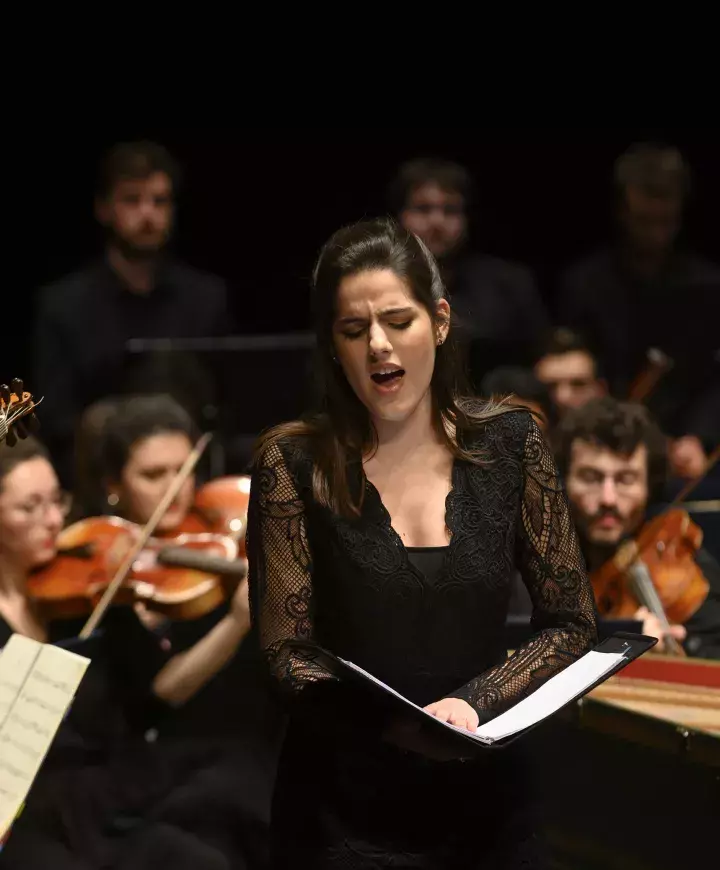
Argentinian conductor, harpsichordist, and composer Leonardo García Alarcón has become a sought-after figure by major musical and opera institutions, from the Opéra de Paris to the Teatro Colón in Buenos Aires and the Grand Théâtre de Genève, where he began his career. After studying piano in Argentina, Leonardo García Alarcón moved to Europe in 1997 and joined the Conservatoire de Genève in the class of harpsichordist Christiane Jaccottet. Under the guidance of Gabriel Garrido, he ventured into Baroque music. In 2005, he founded his ensemble Cappella Mediterranea to explore Italian, Spanish, and South American Baroque music, a repertoire that has since expanded significantly. In residence at the Festival d’Ambronay, he achieved his first successes there, notably with the 2010 rediscovery of an oratorio by Michelangelo Falvetti: "Il Diluvio Universale." That same year, he took the direction of the Chœur de Chambre de Namur, recognized as one of the best Baroque choral ensembles today, and in 2014, he founded the Millenium Orchestra, focusing primarily on the works of Handel. Leonardo García Alarcón is also credited with the rediscovery of numerous operas by Cavalli, such as "Eliogabalo" at the Opéra de Paris in 2016, "Il Giasone" in Geneva, "Elena" and "Erismena" at the Festival d’Aix-en-Provence in 2017, and at the Opéra de Dijon: "El Prometeo" by Antonio Draghi in 2018, for which he rewrote the missing music of the third act, "La Finta Pazza" by Francesco Sacrati in 2019, and "Il Palazzo Incantato" by Luigi Rossi in late 2020, before its revival in Nancy and Versailles at the end of 2021. In 2022, he conducted a new production of Lully's famous "Atys," staged and choreographed by Angelin Preljocaj in Geneva and then in Versailles. Shortly after, he conducted Bach’s "St. Matthew Passion" with Cappella Mediterranea at La Seine Musicale and the Dijon auditorium, receiving high praise from critics. He returned to the Festival d’Aix-en-Provence in July with the successful production of Monteverdi’s "L'Incoronazione di Poppea," directed by Ted Huffman. In September 2022, he made his debut conducting the Concertgebouw Orchestra of Amsterdam for their annual gala, performing Handel’s "Acis and Galatea" (orchestrated by W.A. Mozart). This year also marked a new chapter in his career with the creation of his oratorio "La Passione di Gesù," his first major contemporary composition, warmly received by audiences at the Festival d’Ambronay and Victoria Hall in Geneva, with upcoming performances at the Festival de Saint-Denis and Grand Manège de Namur. As a conductor and harpsichordist, he is invited to festivals and concert halls worldwide. In November 2018, he conducted Monteverdi’s "Orfeo," directed by Sasha Waltz, at the Staatsoper Berlin and is a regular guest of Les Violons du Roy in Canada, the Orchestre Philharmonique de Radio France, and the Gulbenkian Orchestra. He was recognized as the best conductor in the 2019 Forum Opéra rankings after his triumphant direction of "Les Indes Galantes" at the Opéra Bastille. Leonardo García Alarcón divides his time between France, Belgium, his native South America, and Switzerland, where he obtained citizenship. He places great importance on education, serving as a professor of the Maestro Al Cembalo class at the Haute école de musique de Genève since 2002. In 2020, he took on the directorship of La Cité Bleue, a 300-seat performance venue in Geneva currently under renovation, set to open in 2024, with its programming beginning in 2023 with an initial "off-site" season. His prolific discography is widely acclaimed by critics. In 2021, he released "Rebirth" (Sony Classical) with Sonya Yoncheva; "Lamenti & Sospiri" (Ricercar) with Mariana Flores and Julie Roset; Monteverdi’s "Orfeo" (Alpha Classics) with Valerio Contaldo, and "Bach before Bach" (Alpha Classics) with violinist Chouchane Siranossian. In 2022, he released Handel’s "Semele" with Millenium Orchestra and the Chœur de Chambre de Namur (Ricercar), followed by the world premiere recording of Sacrati’s "La Finta Pazza" (Versailles Spectacles). In 2023, "Amore Siciliano" (Alpha Classics), a project he conceived from popular and scholarly music of 17th- and 18th-century Italy, is set to be released. Leonardo García Alarcón is a Chevalier of the Order of Arts and Letters. Learn more about Leonardo García Alarcón.

Leonardo Garcia Alarcon

Departments and associated courses

Events

Organ

Teachers

Alessio Corti

Professor of Organ - Improvisation (for Organists) - Chamber Music with Organ - Organ as a Secondary Instrument

Born in Milan in 1967, the son of a renowned organist and pedagogue, Alessio Corti received his first music lessons at an early age. In 1985, he obtained his piano diploma "cum laude," followed by diplomas in organ and harpsichord. He pursued further studies with internationally renowned organists and was a student of Lionel Rogg at the Conservatoire Supérieur de Genève for three years. In 1992, he won a "Premier Prix de Virtuosité with distinction" and the special "Otto Barblan" prize. He subsequently won First Prizes at the International Competitions of Geneva (C.I.E.M. 1993), Carouge (Switzerland), and the "Froberger Prize" for early music at the International Competition of Kaltern-SüdTyrol. He is also a laureate of several competitions in Italy, notably in Milan. In 1983, he was appointed titular organist of the Grands-Orgues at the Church of Santa Maria Segreta in Milan, where at the age of 18, he performed the Complete Works of D. Buxtehude, and the following year, the Complete Works of J.S. Bach. From 1991 to 2016, he was also the titular organist at the Chiesa Cristiana Protestante in Milan. In his brilliant career, he is regularly invited to major international organ festivals. Alessio Corti plays a wide repertoire of early, romantic, and contemporary music, and his discography comprises around thirty CDs, including a complete recording of J.S. Bach’s organ works and "The Art of Fugue," monographs of W.A. Mozart and Mendelssohn, and several anthologies on historic organs. For the Fugatto label, he recorded a DVD of J.S. Bach's Six Trio Sonatas on the historic (1738) organ of the Kreuzkirche in Suhl, Thuringia. His recordings and recitals have received attention and favorable reviews from international critics. He is often invited as a jury member for major international competitions and to give masterclasses. From 1994 to 2001, he was a professor of organ in Italy at the Conservatories of Udine and Verona, having placed first in the national competition of the Ministry of Public Education. Alessio Corti has been a Professor of Organ and Improvisation at the Haute école de musique de Genève since 2001, succeeding Lionel Rogg. Many of his students have obtained diplomas and master's degrees (concert, soloist, pedagogy), and some have distinguished themselves in international competitions. Learn more about Alessio Corti.

Vincent Thevenaz

Professor of Organ - Improvisation (for organists) - Introduction to Music Reading - Music Reading - Music Reading and Transposition - Chamber Music with Organ

Vincent Thévenaz is a professor of organ and improvisation at the Haute Ecole de Musique de Genève, and the titular organist and carillon player at the St. Peter's Cathedral in Geneva. He is frequently invited for concerts, competition juries, and masterclasses across Europe, Asia, and the Americas. With a comprehensive education spanning organ, piano, classical and jazz improvisation, musicology, music theory, conducting, singing, French and Russian literature, Vincent Thévenaz continuously seeks to invigorate and diversify the organ world. He pushes the boundaries of genres and enriches his interpretations with a profound knowledge of works and their contexts. His repertoire ranges widely from medieval to contemporary and current music of various origins. Vincent Thévenaz has developed a significant focus on improvisation, exploring the power of the present moment. He practices improvisation in liturgy, concerts, and accompanying silent films. His teaching is enriched by an approach that views written music as an endless source of inspiration and improvisation as a questioning of freedom in interpretation. As a recognized specialist in the harmonium, he owns a collection of high-quality historical instruments and performs them in recitals and ensembles. His expertise has led him to collaborate with musicians such as Leonidas Kavakos and Yuja Wang, and with the Scharoun Ensemble of the Berlin Philharmonic, earning praise from Simon Rattle: "played by you, the harmonium becomes a living and exciting instrument." He combines the organ with numerous instruments of diverse origins, including classical (violin, flute) and unusual (saxophone, Alpine horn, percussion) sounds, and plays cousin instruments such as carillon, cinema organ, Hammond organ, keyboards, and percussion. Vincent Thévenaz is also known for his arrangements, transcribing music of various styles for organ or chamber music formations, and collaborating with orchestras and ensembles. He arranged and directed the annual show "Chantons Noël," creating an original setting for traditional melodies. He also arranged a version for ensemble of Mussorgsky's "Pictures at an Exhibition." In 2009-2010, he performed Bach's complete organ works in 14 concerts, followed by Mendelssohn's organ works in 2017, both receiving great acclaim. His duo "W" with saxophonist Vincent Barras has produced two CDs of original repertoire. He has recorded two critically acclaimed CDs with Sony's Ensemble Gli Angeli Genève (Stephan MacLeod). For the 50th anniversary of Geneva Cathedral's Metzler organ, he produced a CD showcasing the treasures of Geneva composers' organ music. Vincent Thévenaz collaborates with numerous ensembles and conductors (Orchestre de la Suisse Romande, Ensemble Contrechamps, Lausanne Chamber Orchestra, Lausanne Vocal Ensemble, Capella Mediterranea, Leonardo Garcia Alarcon, Valery Gergiev, Heinz Holliger, Michel Corboz, Lawrence Foster, Antonio Pappano, etc.). In 2005, he founded the Orchestre Buissonnier, a young musicians' ensemble, which he regularly conducts. Learn more about Vincent Thévenaz.

Alessio Corti
Vincent Thevenaz

Departments and associated courses

Composition

Teachers

Nicolas Bolens

Professor of Counterpoint, 20th-Century Writing, and Practical Writing

En associant traditions et explorations nouvelles des matières sonores, les œuvres de Nicolas Bolens investissent l’espace en valorisant les éléments et les sujets qui se présentent à lui. Combining traditions and new explorations of sound materials, the works of Nicolas Bolens invest in space by enhancing the elements and subjects that present themselves to him. His music is regularly connected to other elements: texts, films, places, evocations... In each context, he seeks an authentic dramaturgy that promotes unprecedented settings. For example, with the Batida ensemble, he imagined "Welcome to the Castle" (2017), three musical acts for musicians moving through the Allymes Castle near Amberieu-en-Bugey. For the Gémeau Quartet, he wrote "La Ville Oblique" (2013), a string quartet conceived as a musical extension of the short film "Un Chien Andalou" by Dalí and Buñuel. Written words, most often poetic, permeate his entire production. He has composed on poems by Celan, Sachs, Mallarmé, Char, Blok, Khayyam, Michaux, Éluard, Basho, Neruda, Rilke, Adonis, Shakespeare... These authors, from various times and origins, have led him to integrate many languages into his works, considering their sonic as well as semantic potentials. Orchestration also holds an important place in his work, rethinking the instrumentation of certain past works. In 2018, he re-orchestrated "Lieder eines fahrenden Gesellen" and the 4th Symphony by Gustav Mahler for the Lemanic Modern Ensemble under the direction of conductor Pierre Bleuse. Commissioned by the association Ouverture Opera, his recent rewriting of Mozart's "The Magic Flute" follows the same approach. Nicolas Bolens has notably collaborated with the Batida ensemble, the Lemanic Modern Ensemble, the Swiss Chamber Soloists, the Ensemble Vocal de Lausanne, the Ensemble Vocal Polhymnia, the Ensemble Vortex, the Basler Madrigalisten, and the Ensemble Vocal Séquence... Born in Geneva, he first studied piano at the Conservatoire de musique de Genève, then completed his training in the composition class of Jean Balissat. He further honed his skills with Rudolph Kelterborn, Klaus Huber, Edison Denisov, and Eric Gaudibert. He is the recipient of numerous composition prizes, including those from the Orchestre de Chambre de Lausanne (1993) and the Banque Cantonale Neuchâteloise (2002), as well as a scholarship from the Leenaards Foundation (1998). An engaged pedagogue and artist, he teaches counterpoint, 20th-century writing, and composition at the Haute école de musique de Genève, where he has been the head of the Composition and Theory Department from 2015 to 2024. He is also involved in several institutions related to musical creation in Switzerland, including the Swiss Musicians Association, the Archipel Festival Association, the Nicati-de-Luze Foundation, and the Artistic Council of the Geneva Competition. Learn more about Nicolas Bolens  

Luis Naon

Professor of Electroacoustic Composition - Mixed Composition

Born in La Plata, Argentina, in 1961, Luis Naon pursued his musical studies at the Universidad Nacional de La Plata, Universidad Católica Argentina in Buenos Aires, and later at the CNSM de Paris under the guidance of Guy Reibel, Laurent Cuniot, and Daniel Teruggi. He also studied with Sergio Ortega and Horacio Vaggione. Since 1991, he has been a professor of Composition and New Technologies at the Conservatoire National Supérieur de Musique de Paris. Additionally, he taught composition at ESMUC (Barcelona) from 2003 to 2008 and has been a professor of electroacoustics at the HEM de Genève since 2006. From what could be considered his first work, "Final del Juego" for septet and magnetic tape (premiered at Studio 105 of Radio France in 1983), Naon has sought to implement this dual relationship (between America and Europe, between instruments and electronics). He has been awarded the UNESCO International Composers Tribune in 1990 and 1996 (for "Tango del desamparo" and "Speculorum Memoria"), the Fondo Nacional de las Artes (for "Reflets"), the TRINAC Prize from the International Music Council (for "Cinq personnages en quête de hauteur"), the Olympia Composition Prize (for "Ombre de l'ombre"), and the Municipal Prize of the City of Buenos Aires in 1991 and 1995 (for "Speculorum Memoria"). He was nominated for the "3rd Victoires de la Musique Classique" (for Sextuor ". "), "Prix Georges Enesco" from SACEM, and "Luis de Narváez" Prize from Caja de Granada for his String Quartet No. 2. Naon collaborates with various ensembles and institutions such as the Ministry of Culture and Communication, Teatro Colón (Buenos Aires), Musée d’Art Contemporain du Mexique, Orchestre de la Seine-Saint-Denis, Ensemble TM+, Lémanic Modern Ensemble, Interface, Musique Oblique, Musée d’Histoire de Montreuil, Orchestre Philharmonique de Radio France, INA-GRM, IRCAM, Orchestre de Paris, Ensemble Contrechamps, Ensemble Diagonal, Ukho ensemble de Kiev, and in festivals like Musica Strasbourg, MANCA, Festival d'Aix en Provence, Festival Archipel, and Vivier de Montréal. In 1989, Naon composed the music for the parade on the Champs-Elysées and Place de la Concorde commemorating the Bicentennial of the French Revolution. This parade was televised worldwide. The cycle of 25 works "Urbana," initiated in 1991 and completed in 2013, crystallizes under this generic title through "Urbana" (1997). It includes 25 works ranging from acousmatic pieces to symphonic orchestra. He composed the music for the show "Les Princesses" for the opening of the Théâtre-Auditorium de Poitiers in partnership with choreographer Odile Azagury. Nearly 3 hours of music ranging from solo electroacoustic (for choreographers Anna Ventura, Karine Saporta, or Dominique Boivin) to pieces for 15 instruments and electronics (for choreographers Carolyn Carlson, Héla Fatoumi, Blanca Li, etc.). This entire production is captured on a double CD under the Empreinte Digitale label. Recent works include "Quebrada/Horizonte" for orchestra, "Pájaro al borde de la noche" for cello, electronics, and ensemble premiered at the recent Présences festivals of Radio France, "Ébano y Metal" for the Lemanic Modern Ensemble (Switzerland/France). Other notable recent works include "Rastros" for the ensembles Stick & Bow and Paramirabo of Montreal (featured in a monographic concert and video recording) and his "String Quartet III" (premiered at the Evora Festival in 2021, then at Archipel 2022 and projection space of IRCAM in 2023). His latest piece, "Fueye," concertino for bandoneon and ensemble, was premiered by Juanjo Mosalini and the TM+ ensemble at the Maison de la Musique de Nanterre in October 2022, followed by performances at La Seine Musicale and Gennevilliers in May 2023. Naon's works are published by Henry Lemoine, Gérard Billaudot, and Babelscores. Learn more about Luis Naon.

Gilbert Nouno

Head of the CIMME - Professor of Electronic Music - Multimedia Composition - Interactive Video Design - Internet Music - Interfaces, Digital Instrument Making & Immersive Systems - Concept & Creation, Open Space

Composer, sound artist, pedagogue, and researcher, Gilbert Nouno creates music that is highly in tune with visual arts and digital technologies. Curious about all forms of expression, he effortlessly crosses the boundaries between composition and improvisation. As a visual artist under the name Til Berg, he combines the synesthesia of sound arts with other media. Using music and sounds, he generates abstract and minimalist visuals with traditional and digital media such as video and lithography. Gilbert Nouno's collaborations are marked by aesthetic plurality with many artists such as Pierre Boulez and the Berlin Philharmonic Orchestra, George Benjamin and the London Sinfonietta, Jonathan Harvey and the Arditti Quartet, saxophonist Steve Coleman, and flutist Magic Malik... A laureate of the Villa Kujoyama in Kyoto in 2007, and the Villa Medici, Académie de France in Rome in 2011-2012, Gilbert Nouno teaches composition and runs the International Center for Experimental Music and Media (CIMME) at the Haute école de musique de Genève, teaches composition at the Royal College of Music in London , and is a visiting professor invited by the DAAD in Detmold (Germany). He teaches digital sound arts at Goldsmiths, University of London, where he is also a guest researcher, and live electronics & computer music design at Ircam. Learn more about Gilbert Nouno

Katharina Rosenberger

Professor of composition

The works of composer Katharina Rosenberger take listeners to unknown places. Born in Zurich in 1971, the artist takes an interdisciplinary approach and uses unusual combinations. Her works draw on artistic fields and media such as video, visual arts and theatre. Her sound art and sound sculptures challenge our listening habits and draw attention to the way we perceive music and works of art. Katharina Rosenberger studied at the prestigious Berklee College of Music in Boston, the Royal Academy of Music in London and Columbia University in New York. Since 2018, she has been a professor at the University of California, San Diego, where she previously taught composition and sound art. In 2021, she was appointed professor of composition in Lübeck. In 2019, Katharina Rosenberger received the prestigious Guggenheim Fellowship. Katharina Rosenberger's works have received numerous awards; her project ‘VIVA VOCE’ was supported by the Federal Office of Culture and her album ‘TEXTUREN’, performed by the New York ensemble Wet Ink, received the prestigious Copland Recording Grant and the Deutsche Schallplattenkritik prize. Katharina Rosenberger's works can be discovered at international festivals. Attending a live performance is an experience that leaves a lasting impression on the senses.

Nicolas Bolens
Naon
Gilbert Nouno
Photo portrait de Katharina Rosenberger

Departments and associated courses

Témoignages

Acoustics and musical conducting

Teachers

Samuel Albert

Acoustique et régie musicale - séminaire d'acoustique

Departments and associated courses

The piano as a second instrument

Teachers

Ioana Avramescu

Professeure de piano comme instrument secondaire MA

Raphaël Colin

Nathalie Dieufils Cardot

Chargé de cours HES

Birgit Frenk-Spilliaert

Chargé de cours HES

Raphaël Gogniat

Professeur d'Harmonie au clavier - Harmonie au clavier et improvisation (pour les pianistes) - Piano comme instrument secondaire

David Marteau

Professeur d'Harmonie au clavier - Harmonie au clavier et improvisation (pour les pianistes) - Piano comme instrument secondaire

Jamal Moqadem

Professeur d'Harmonie au clavier - Piano comme instrument secondaire

Veneziela Naydenova

Didactique Instrumentale (piano NE)

Christophe Sturzenegger

Professeur d'Harmonie au clavier - Harmonie au clavier et improvisation (pour les pianistes) - Piano comme instrument secondaire - Coordination harmonie au clavier et piano comme instrument secondaire

Johann Vacher

Professeur d'Atelier de recherche Master - Harmonie au clavier - Piano comme instrument secondaire - Coordinateur de la musique contemporaine

Audrey Vigoureux

Professeure de piano comme instrument secondaire

Naydenova_Veneziela
Photo portrait d'Audrey Vigoureux

Departments and associated courses

The practice of writing

Teachers

Nicolas Bolens

Professor of Counterpoint, 20th-Century Writing, and Practical Writing

En associant traditions et explorations nouvelles des matières sonores, les œuvres de Nicolas Bolens investissent l’espace en valorisant les éléments et les sujets qui se présentent à lui. Combining traditions and new explorations of sound materials, the works of Nicolas Bolens invest in space by enhancing the elements and subjects that present themselves to him. His music is regularly connected to other elements: texts, films, places, evocations... In each context, he seeks an authentic dramaturgy that promotes unprecedented settings. For example, with the Batida ensemble, he imagined "Welcome to the Castle" (2017), three musical acts for musicians moving through the Allymes Castle near Amberieu-en-Bugey. For the Gémeau Quartet, he wrote "La Ville Oblique" (2013), a string quartet conceived as a musical extension of the short film "Un Chien Andalou" by Dalí and Buñuel. Written words, most often poetic, permeate his entire production. He has composed on poems by Celan, Sachs, Mallarmé, Char, Blok, Khayyam, Michaux, Éluard, Basho, Neruda, Rilke, Adonis, Shakespeare... These authors, from various times and origins, have led him to integrate many languages into his works, considering their sonic as well as semantic potentials. Orchestration also holds an important place in his work, rethinking the instrumentation of certain past works. In 2018, he re-orchestrated "Lieder eines fahrenden Gesellen" and the 4th Symphony by Gustav Mahler for the Lemanic Modern Ensemble under the direction of conductor Pierre Bleuse. Commissioned by the association Ouverture Opera, his recent rewriting of Mozart's "The Magic Flute" follows the same approach. Nicolas Bolens has notably collaborated with the Batida ensemble, the Lemanic Modern Ensemble, the Swiss Chamber Soloists, the Ensemble Vocal de Lausanne, the Ensemble Vocal Polhymnia, the Ensemble Vortex, the Basler Madrigalisten, and the Ensemble Vocal Séquence... Born in Geneva, he first studied piano at the Conservatoire de musique de Genève, then completed his training in the composition class of Jean Balissat. He further honed his skills with Rudolph Kelterborn, Klaus Huber, Edison Denisov, and Eric Gaudibert. He is the recipient of numerous composition prizes, including those from the Orchestre de Chambre de Lausanne (1993) and the Banque Cantonale Neuchâteloise (2002), as well as a scholarship from the Leenaards Foundation (1998). An engaged pedagogue and artist, he teaches counterpoint, 20th-century writing, and composition at the Haute école de musique de Genève, where he has been the head of the Composition and Theory Department from 2015 to 2024. He is also involved in several institutions related to musical creation in Switzerland, including the Swiss Musicians Association, the Archipel Festival Association, the Nicati-de-Luze Foundation, and the Artistic Council of the Geneva Competition. Learn more about Nicolas Bolens  

Charlotte Perrey Beaude

Professor of Writing Practice - Cadence Writing - Music Theory

Charlotte Perrey began her musical studies with piano, quickly developing a strong inclination for improvisation and composition. After studying in advanced mathematics classes, she fully devoted herself to music and specialized in writing under the guidance of Stéphane Delplace. She continued her studies at the Conservatoire National Supérieur de Paris, where she earned First Prizes in Harmony, Counterpoint, 20th-21st Century Writing, Fugue and Forms, as well as the Marcel Dautremer Prize. She studied notably with Jean-François Zygel, Thierry Escaich, and Marc-André Dalbavie. She currently teaches at the Haute école de musique de Lausanne and the Haute école de musique de Genève.

Rodolphe Schacher

Professor of Writing Practice - Analysis - Harmony - Counterpoint

Franco-Swiss composer and pianist Rodolphe Schacher was born in France in 1973. Schacher pursued his musical studies in Paris, Geneva, and Zurich, under the guidance of Michael Jarrell, Thierry Escaich, Gerald Bennett, and Ulrich Koella. He has been awarded five first prizes (harmony, counterpoint, Renaissance counterpoint, fugue and forms, and 20th-century music) at the CNSM in Paris and received the composition and theory diploma with honors, as well as the concert diploma in chamber music from the Zurich University of the Arts. Alongside his artistic activities, Schacher teaches analysis and writing at the Haute école de musique de Genève, writing at the Haute école de musique de Lausanne, and taught composition until June 2015 at the Zurich University of the Arts.

Antoine Schneider

Professor of Practical Writing - Contrepoint

After studying violin and musicology in Geneva, Antoine Schneider furthered his musical theory education in Zurich with Burkhard Kinzler and Andreas Nick. He also trained in musical direction, piano, and baroque violin. He is currently a professor of solfège and counterpoint at the Haute école de musique de Genève and the Haute école des arts de Berne, as well as a professor of musical training at the ESM Bourgogne-Franche-Comté (Early Music Department). In his teaching, he specializes in the practices of musical improvisation during the Renaissance period. He is regularly invited to give masterclasses across Europe and collaborates with Jean-Yves Haymoz, Barnabé Janin (CNSMD Lyon), and the Helicona project. He is the co-responsible for the website Super librum cantare (www.superlibrum.com).

Nicolas Bolens
Perrey
Schacher
antoine schneider

Departments and associated courses

Events

Piano (Jaques-Dalcroze)

Teachers

Sarah Branchi-Cascone

Professor of piano Jaques-Dalcroze

Born in Aix-en-Provence, Sarah Branchi Cascone began her musical studies there, later completing them at the CRR of Montpellier. After obtaining Diplomas in Musical Studies in piano and chamber music, she joined the Cefedem-Sud (now IESM) at a very young age, where she earned a piano teaching diploma. Her musical journey then led her to the Haute école de musique de Genève (HEM) to continue her studies in the class of Dominique Weber. There, she obtained a teaching diploma and later a concert diploma. Passionate about pedagogy and teaching from a young age, Sarah Branchi Cascone has been teaching piano since 2003 at the Institut Jaques-Dalcroze and within the Master’s in Pedagogy program, Jaques-Dalcroze orientation, at HEM. She has performed as a soloist and in various chamber music formations in Switzerland, France, and Argentina. In 2008, she founded the Tashko-Branchi duo with pianist Olta Tashko. The two pianists regularly perform recitals in France and Switzerland. In 2017, they participated in the complete concertos of J.S. Bach for 2, 3, and 4 pianos with the Terpsycordes Quartet. In 2019, they premiered the show "Vagabond et Visionnaire" by S. Arnauld, based on poems by F. Nietzsche.

Stephane Ginsburgh

Professor of Jaques-Dalcroze Piano

Stéphane Ginsburgh has performed as a soloist and chamber musician at numerous international festivals such as Ars Musica, Quincena Musical, ZKM Imatronic, Agora Ircam, Bach Academie Brugge, Ultima Oslo, Darmstadt Ferienkurse, Gaida (Vilnius), Warsaw Autumn, Musica Strasbourg, Klara Festival, and the Accademia Chigiana in Siena. A tireless explorer of the repertoire and an adventurer in new combinations involving voice, percussion, performance, or electronics, he dedicated himself early on to contemporary music while developing a vast classical repertoire. He regularly performs with the Ictus ensemble and has collaborated with composers such as Frederic Rzewski, Jean-Luc Fafchamps, Stefan Prins, Alec Hall, and Matthew Shlomowitz, premiering their works. He has also worked with choreographers such as Anne Teresa De Keersmaeker. Enthusiastic about immersive performances, Stéphane Ginsburgh has performed the complete Prokofiev sonatas or the last six Beethoven sonatas in a single evening. After earning a Master's degree in music, he studied with Paul Badura-Skoda, Claude Helffer, Jerome Lowenthal, and Vitaly Margulis. He was the artistic director of the Centre Henri Pousseur, a studio for mixed and electronic music based in Liège. He holds a Bachelor's degree in the philosophy of science from the Université Libre de Bruxelles and a PhD in Arts from the Vrije Universiteit Brussel and the Koninklijk Conservatorium Brussel. Stéphane Ginsburgh has recorded about fifteen albums for Sub Rosa, World Edition, Grand Piano (Naxos), and Kairos. His complete recording of Prokofiev's Piano Sonatas, described as a “captivating” and “essential” version (La Libre Belgique), was released by Cypres Records. Learn more about Stéphane Ginsburgh.

Photo Sarah Branchi
Photo Stéphane Ginsburgh

Departments and associated courses

Events

Ethnomusicology

Teachers

Talia Bachir-Loopuyt

Head of the Ethnomusicology Program - Professor of Ethnomusicology

Talia Bachir-Loopuyt is an ethnomusicologist and anthropologist specialising in the music of the Maghreb and the Middle East (in particular Turkey), and studying its dissemination and transmission in Europe (Germany, France, Switzerland). She trained in Germanic Studies at the École Normale Supérieure in Lyon (leading to the Agrégation, 2004), while also studying oriental music (oud, kementche, modal improvisation) at the École Nationale de Musique in Villeurbanne and in Turkey. Her dissertation, written under the joint supervision of EHESS Paris and Humboldt University (Berlin), focused on world music festivals and the ideal of a plural society in Germany. As a post-doctoral researcher (University of Saint-Etienne, University of Lausanne), she worked on the dissemination of Turkish music in France and on the visibility of Islam, while pursuing work on the history of ethnomusicology, child musicians and music in plural societies. Since 2016, she has been a senior lecturer at Tours, where she contributed in particular to the creation of the Master Music and Human Sciences (with the University of Poitiers). Involved in several academic organisations (SFE, IMS, ICTM) and journal committees, she is also co-director of the Haizebegi festival in Bayonne and a member of the scientific board of the CMTRA - Ethnopôle Musique, territoires, interculturalité.

Patrik Vincent Dasen

Professor of Ethnomusicology, Master’s Research Seminar, World Music Workshop

Patrik Dasen graduated in ethnomusicology from the Université Paris X Nanterre (Maîtrise, 1999) and the Université de Nice Sophia-Antipolis (Master 2, 2009), where he also completed a doctoral thesis in March 2020 entitled "Becoming and Being a Maker of Irish Bagpipes Uilleann Pipes: Between Deterritorialization and Heritage Preservation," under the supervision of Prof. Luc Charles-Dominique. His research focuses on the processes of transmission and heritage preservation of musical traditions. He worked for ten years at the Ateliers d'ethnomusicologie de Genève as the head of educational activities and public relations. He also led, with a small team, the cataloging and digitization campaign of the Archives Internationales de Musique Populaire (AIMP, 2005-2011) by Constantin Brailoiu, which are now fully accessible at the Musée d'ethnographie de Genève thanks to this preservation effort. He has been teaching ethnomusicology and the sociology of contemporary music at the Haute école de musique de Genève since 2008. Learn more about Patrik Vincent Dasen

L’ethnologue et musicologue Talia Bachir-Loopuyt
Patrick Dasen

Departments and associated courses

Events

Pedagogy

Teachers

Carine Tripet Lièvre

Responsible of pedagogical programs - Professor of Education Sciences

Holder of a PhD in Social and Political Sciences, specializing in Education Sciences, Carine Tripet is also a musician. Coming from a jazz background but specialized in world vocal music, she is active in Valais where her musical projects revolve around immigration issues and Valaisan heritage. She received the Musique Pro Valais cultural scholarship for the period 2014-2017 with her project ViaVallesia. Formerly a professor at the Haute Ecole Pédagogique du Valais, where she led several programs, she also taught Applied Education Sciences in Music Education for six years at HEMU. The content of her courses is decidedly interdisciplinary, drawing from various relevant disciplines (including, but not limited to: didactics, sociology, developmental psychology, neuroscience, ethics, law), to establish a solid network of concepts and notions that enable young teachers to self-analyze their practice. Her research focuses on the construction of the professional identity of music teachers in connection with cultural democracy. Since 2022, she has been coordinating the pedagogy program at the Haute Ecole de Musique de Genève.

Carine tripet

Departments and associated courses

Instrumental improvisation

Teachers

Pablo Ernesto Cernik

Professor of Keyboard Harmony and Jaques-Dalcroze Writing - Instrumental Improvisation - Physical and Mental Preparation: Bodily Approach to Music through Jaques-Dalcroze Eurhythmics - Jaques-Dalcroze Eurhythmics - Jaques-Dalcroze Solfège

Pablo Cernik is currently employed as an adjunct professor, teaching in the Bachelor’s degree, Master’s degree, and CAS programs in the Music and Movement Department at the Haute école de musique de Genève (HEM). He collaborates with the department's administration on tasks related to the visibility of the programs and also with the Institut Jaques-Dalcroze in coordinating the Diplôme Supérieur. He is the director of the Dalcroze Certificate programs in Italy, Spain, Chile, and Argentina. He has significantly contributed to the dissemination of the method by conducting workshops and conferences in various regions and countries across Europe, Asia, and Latin America. As an opera, chamber music, and dance pianist, his presentations have placed particular emphasis on multidisciplinary creation. He is currently pursuing a PhD in Arts at the Universidad Nacional de las Artes (UNA) in Buenos Aires. He is a member of the Jaques-Dalcroze College and the central committee of the International Federation of Eurhythmics Teachers (FIER). He is also the president of the Dalcroze Association of Argentina.

Hélène Nicolet

Professor of Instrumental Improvisation - jaques-Dalcroze Eurhythmics

Hélène Nicolet was born in Geneva, Switzerland, and began her musical journey through Dalcroze Eurhythmics at the Jaques-Dalcroze Institute from a young age. With a jazz musician father and an educator mother, her artistic path has been deeply influenced by improvisation and a corporeal approach. She obtained her teaching license in the Dalcroze method in 2006 (awarded for the best level of license, best adult lesson, and best rhythmic exam). Her commitment to teaching was further solidified when she earned a Master of Music Diploma from the Haute école de musique de Genève. During her stay in New York in 2011, she enhanced her interest in movement by becoming a Certified Movement Analyst at the Laban/Bartenieff Institute of Movement Studies. In 2013, she completed her Advanced Diploma at the Jaques-Dalcroze Institute, the highest title allowing her to fully teach and represent the method (Eurhythmics, Solfege, Improvisation). Alongside her professional training, Hélène Nicolet studied classical piano and received the amateur certificate from the Federation of Music Schools with honors from the jury. She continued her piano study through jazz and classical improvisation. She started playing the cello in her teens and participated in various musical formations (accompanist for opera singers or instrumentalists, baroque trio, jazz-folk duo, and jazz quartet). Currently, she teaches students in the Music and Movement department (Bachelor, Master, and CAS in Dalcroze Eurhythmics). She is frequently invited abroad to teach and present the Jaques-Dalcroze method at various universities and partner centers. Additionally, she works at the Jaques-Dalcroze Institute, where she has been the director since August 2023. Research Projects Proceedings of the Jaques-Dalcroze Institute Congress: https://www.hesge.ch/hem/recherche-developpement/projets-recherche/termine/actes-du-congres-linstitut-jaques-dalcroze Publications Silvia Del Bianco, Sylvie Morgenegg, Hélène Nicolet, Pédagogie, art et science: l’apprentissage par et pour la musique selon la méthode Jaques-Dalcroze, actes du Congrès de l’ijd 2015, Editions Droz et HEM, 2017. https://www.hesge.ch/hem/publications/pedagogie-art-et-science Mary Brice, Ruth Gianadda, Hélène Nicolet, « Racines d’une pratique encore en mouvement », 2019. https://www.dalcroze.ch/wp-content/uploads/2021/12/Racines-dune-pratique-encore-en-mouvement.pdf Mary Brice, Ruth Gianadda, Hélène Nicolet, « Roots of a practice still in movement », 2019. https://www.dalcroze.ch/wp-content/uploads/2021/12/Roots-of-a-practice-still-in-movement.pdf

Stéphane Orlando

Professeur d'Ateliers d'improvisation (coordinateur) - Harmonie au clavier et écriture Jaques-Dalcroze - Improvisation instrumentale

Lauréat du prix SABAM for culture pour la musique contemporaine en 2020, le pianiste et compositeur Stéphane Orlando collabore régulièrement avec plusieurs musicien-ne-s, ensembles et orchestres. Depuis 2022, il est devenu compositeur en résidence à l'Orchestre Philharmonique Royal de Liège. Stéphane Orlando puise son inspiration dans la musique classique, traditionnelle et le jazz, mais aussi dans sa propre pratique de l'improvisation au piano. Il aime aussi bien composer pour un seul instrument ou en musique de chambre, avec ou sans électronique, que pour orchestre, mais il aime surtout inscrire sa musique dans un contexte narratif riche, avec une forte sensibilité pour les images, les mots et les mouvements. Stéphane Orlando enseigne l’improvisation instrumentale à la Haute école de musique de Genève (HEM). En savoir plus sur Stéphane Orlando

Laurent Sourisse

Professeur d'improvisation instrumentale - improvisation instrumentale Jaques-Dalcroze - Harmonie au clavier et écriture - Accompagnement de chansons

Né en 1970 dans une famille de musiciens, Laurent Sourisse étudie au CNSM de Paris avec Thierry Escaich (Fugue et Formes), Marc-André Dalbavie (Orchestration), Alain Louvier (Analyse), Jean-Claude Reynaud (Harmonie) et Bernard de Crépy (Contrepoint), il se perfectionne en improvisation au piano auprès de Thierry Escaich, Alain Savouret, et Isabelle Duha. Il enseigne l’écriture, l’harmonie pratique, et l’improvisation sur Paris, puis sur Genève depuis 2001. Il est fréquemment sollicité pour des masterclasses et congrès à l’étranger (Taïwan, Japon, Canada, Belgique, France, Espagne), et pour des formations continues et postgrades. Au sein du trio Meigmata (avec Marie Mercier, clarinette, et Michael Chapon, batterie), il explore l’improvisation aux multiples influences et la composition collective. Il expérimente également l’association avec d’autres pratiques artistiques : danse (Florence Jaccottet, Luisa Schöfer), marionnettes (Fanfare du Loup, Théâtre de Marionnettes de Genève), matchs d’improvisation (impro.ch et HEM).

Photo Pablo Cernik
Hélène Nicolet©CaroleParodi
Photo Stéphane Orlando
Photo Laurent Sourisse

Departments and associated courses

Subscribe to