Mirela
Vedeva Ruaux
Professor of Double Bass
Mirella Vedeva received a virtuosity prize from the Conservatoire de Genève and graduated from the Giovanni Bottesini International Double Bass Competition. Michel Plasson, who noticed her during this competition, hired her as a soloist for the Orchestre du Capitole de Toulouse. She has also collaborated with other symphonic ensembles such as the Orchestre de la Suisse Romande de Genève, the Lausanne Chamber Orchestra, the Geneva Chamber Orchestra, and the Lausanne Sinfonietta.
Her passion for imparting her instrumental knowledge drives her towards teaching. At the Conservatoire de Genève and the Accademia, she created classes for very young double bassists starting from the age of six. In charge of directing the Music School Orchestra of the Conservatoire de Genève, she has carried out numerous educational projects.
At the Haute école de musique de Genève (HEM), she receives students from around the world, perpetuating the tradition of excellence from the school of her mentor Franco Petracchi.
She is also a professor at the Conservatoire Supérieur de Saragosse. Invited for numerous masterclasses in Italy, Spain, France, Switzerland, and China, her pedagogical talents are universally recognized.
Lastly, her activities as a soloist and chamber musician have garnered her much success both in Switzerland and abroad.
Learn more about Mirella Vedeva Ruaux.
Gerardo Gustavo
Vila
Professor of Chamber Music – Coordinator of Chamber Music (NE)
Born in Buenos Aires, Gerardo Vila showed remarkable talent from a young age. He developed an intense musical career, earning the diploma of "National Superior Piano Professor" from the National Conservatory of Music and winning six first prizes, including the "Vicente Scaramuzza" competition, which allowed him to perfect his skills in Europe.
He continued his studies at the Conservatoire de Genève with Maria Tipo, where he obtained the first prize in virtuosity with distinction and the Henry Broillet prize. Later, he worked with Karl Engel at the Conservatory of Bern and participated in masterclasses with Louis de Moura Castro, György Sandor, Tatiana Nikolayeva, Vlado Perlemuter, and Maurizio Pollini.
Winner of numerous international piano competitions, he received, among others, the first prize at the "Maria Canals" competition in Barcelona, the second prize at the "Alessandro Casagrande" competition in Terni/Italy, and the "World Piano Competition" in Cincinnati/USA.
Vila has undertaken numerous tours in Europe, Latin America, and the United States, performing in venues such as Teatro Colón in Buenos Aires, Palau de la Música in Barcelona, Piccolo Teatro di Milano, Teatro Massimo di Palermo, Espace Pierre Cardin in Paris, Théâtre Roma in Warsaw, Kleine Musikhalle in Hamburg, Alte Oper in Frankfurt, Kaufleutensaal in Zurich, University Hall in Helsinki, Omni Hall of Mirrors in Cincinnati, Casino de Berne, Casino Kursaal in Interlaken, Max-Joseph-Saal in the Residenz in Munich, Fondation Pierre Gianadda in Martigny, Salle Métropole in Lausanne, Slovak Philharmonic Hall in Bratislava, Herkulessaal in Munich, and the Sydney Opera House.
He has performed as a soloist with renowned orchestras such as the Orchestre de la Suisse Romande, the Perugia Orchestra, the AMSA World Symphony in Cincinnati, the Barcelona City Orchestra, the Janáček Philharmonic Orchestra, the Dresden Philharmonic, the Lausanne Chamber Orchestra, and the Bern Symphony Orchestra, under the direction of conductors including Arpad Gerecz, Jun Märkl, Albert Rosen, Frank Cramer, Dennis Burkh, Jörg Peter Weigle, Miguel Gómez Martínez, Christian Arming, Laurent Gendre, Carlos Kalmar, Hans Zender, and Michel Tabachnik.
Gerardo Vila has had the privilege of performing in recitals with the prestigious pianist Karl Engel and playing in the Camerata Lysy with Sir Yehudi Menuhin. He possesses extensive experience in chamber music, having played with Ana Chumachenko, Alberto Lysy, Radu Aldulescu, Rachel Harnisch, Alexandru Gavrilovici, Thomas Friedli, Patrick Demenga, Gyula Stuller, Marcio Carneiro, Karl Engel, and Davide Bandieri.
For many years, he has given masterclasses in Switzerland, Romania, and Latin America.
Vila is a member of the ensemble "I Salonisti" and the 676 NuevoTango Quintet. He continues to perform as a soloist and with various chamber music ensembles.
He has made several recordings for VDE-Gallo, Zytglogge, Vox, Naxos, and Brillant Classics.
Since its inception, Vila has been a professor of chamber music at the Haute École de Musique de Genève, Neuchâtel site, where he also serves as the coordinator.
Learn more about Gerardo Gustavo Vila
Antoine
Marguier
Professor of Bass Clarinet / Woodwind Chamber Music / Orchestral Excerpts in Section or Group (Winds) / Orchestral Sight-Reading
Graduating in clarinet and chamber music from the CNSM de Lyon, Antoine Marguier began his career under the direction of Claudio Abbado with the Orchestre des Jeunes de l’Union Européenne and the Gustav Mahler Jugend Orchester.
At the age of 22, he was appointed as the solo bass clarinet at the Orchestre de la Suisse Romande, a position he held for 16 years.
His passion for ensemble music and his desire to pass on his knowledge led him to join the HEM at the age of 27, first as a professor of bass clarinet, then of chamber music and orchestral excerpts, and as a conductor, notably during a tour in China.
As part of the school's international collaborations, he has given masterclasses at the Yong Siew Toh Conservatory of Music in Singapore, Seoul National University, the Conservatoire Central de Pékin, and the Jerusalem Academy of Music and Dance.
Among his mentors and teachers are renowned conductors such as David Zinman, Roberto Benzi, James Levine, and Kurt Masur.
Alongside his international activity as a guest conductor, he has held positions as resident conductor of the Orchestre National de Lyon, music director of the Orchestre du Conservatoire de musique de Genève, and the Seoul International Community Orchestra.
In Geneva, where he resides, he is the founder and conductor of the Compagnie du Rossignol and the Orchestre des Nations, through which he has had the opportunity to accompany great musical personalities such as Renée Fleming, Khatia Buniatishvili, Maxim Vengerov, Gautier Capuçon, Alexandra Conunova, Barbara Hannigan, Miloš Karadaglić, and Pretty Yende.
Also in Geneva, Antoine is a member of the Club Diplomatique and the Cercle des Entrepreneurs.
Learn more about Antoine Marguier.
Quatuor Belcea
Quatuor en résidence
Composé de Corina Belcea (violon), Suyeon Kang (violon), Krzysztof Chorzelski (alto) et Antoine Lederlin (violoncelle), le Quatuor Belcea bénéficie d’une solide réputation sur la scène musicale internationale et affiche déjà une discographie impressionnante. L’éventail de son répertoire embrasse toute la musique écrite pour quatuor de Haydn, Mozart, et Beethoven, jusqu’à Bartok, Janacek, Britten et Szymanowski. En outre, il présente régulièrement au public des œuvres de compositeurs actuels.
La présence du Quatuor Belcea au sein de la HEM représente une opportunité unique pour les étudiant-e-s de bénéficier d’une formation pratique et théorique complète dispensé par un ensemble expérimenté connaissant parfaitement toutes les facettes du métier de musicien-ne. Nul doute que le professionnalisme, la curiosité et l’éclectisme du Quatuor Belcea seront des sources d’inspiration pour nos étudiant-e-s tant dans le répertoire classique que contemporain.
Site internet du Quatuor Belcea
Nina
Uhari
Head of Vocal Department - Professor of Piano Accompaniment - Chamber Music with Piano
Born in Finland, Nina Uhari pursued professional piano studies at the Sibelius Academy in Helsinki under the guidance of Matti Raekallio and Eero Heinonen. She furthered her training in Baltimore, USA, with Julian Martin, and later in Paris with Bernard Ringeissen. Additionally, she studied accompaniment at the Conservatoire National de Région in Rueil-Malmaison.
Following her studies, Nina Uhari worked as a conductor at CNIPAL (Centre National d'Insertion pour des Artistes Lyriques) in Marseille from 2003 to 2012, where she became the principal conductor in 2008. Concurrently, she was a member of the opera role class at the Ecole Normale de Musique de Paris.
In September 2012, Nina Uhari joined the HEM (Haute Ecole de Musique) in Geneva as a vocal coach for the singing classes at the Neuchâtel and Geneva sites. She has performed in recitals and opera productions in Finland and France, including at the MIDEM Festival, Chorégies d'Orange, Théâtre du Châtelet, Festival de Radio France et Montpellier, Festival d'Aix en Provence, and various French opera houses. Her international performances have taken her to Germany, Austria, Spain, Colombia, Togo, and the United States. She has been invited to accompany master classes with renowned artists such as Tom Krause, Yvonne Minton, Mady Mesplé, Regina Werner, and Janine Reiss.
Learn more about Nina Uhari.
Pablo Ernesto
Cernik
Professor of Keyboard Harmony and Jaques-Dalcroze Writing - Instrumental Improvisation - Physical and Mental Preparation: Bodily Approach to Music through Jaques-Dalcroze Eurhythmics - Jaques-Dalcroze Eurhythmics - Jaques-Dalcroze Solfège
Pablo Cernik is currently employed as an adjunct professor, teaching in the Bachelor’s degree, Master’s degree, and CAS programs in the Music and Movement Department at the Haute école de musique de Genève (HEM). He collaborates with the department's administration on tasks related to the visibility of the programs and also with the Institut Jaques-Dalcroze in coordinating the Diplôme Supérieur.
He is the director of the Dalcroze Certificate programs in Italy, Spain, Chile, and Argentina. He has significantly contributed to the dissemination of the method by conducting workshops and conferences in various regions and countries across Europe, Asia, and Latin America. As an opera, chamber music, and dance pianist, his presentations have placed particular emphasis on multidisciplinary creation. He is currently pursuing a PhD in Arts at the Universidad Nacional de las Artes (UNA) in Buenos Aires. He is a member of the Jaques-Dalcroze College and the central committee of the International Federation of Eurhythmics Teachers (FIER). He is also the president of the Dalcroze Association of Argentina.
Talia
Bachir-Loopuyt
Head of the Ethnomusicology Program - Professor of Ethnomusicology
Talia Bachir-Loopuyt is an ethnomusicologist and anthropologist specialising in the music of the Maghreb and the Middle East (in particular Turkey), and studying its dissemination and transmission in Europe (Germany, France, Switzerland). She trained in Germanic Studies at the École Normale Supérieure in Lyon (leading to the Agrégation, 2004), while also studying oriental music (oud, kementche, modal improvisation) at the École Nationale de Musique in Villeurbanne and in Turkey.
Her dissertation, written under the joint supervision of EHESS Paris and Humboldt University (Berlin), focused on world music festivals and the ideal of a plural society in Germany. As a post-doctoral researcher (University of Saint-Etienne, University of Lausanne), she worked on the dissemination of Turkish music in France and on the visibility of Islam, while pursuing work on the history of ethnomusicology, child musicians and music in plural societies.
Since 2016, she has been a senior lecturer at Tours, where she contributed in particular to the creation of the Master Music and Human Sciences (with the University of Poitiers). Involved in several academic organisations (SFE, IMS, ICTM) and journal committees, she is also co-director of the Haizebegi festival in Bayonne and a member of the scientific board of the CMTRA - Ethnopôle Musique, territoires, interculturalité.
Laurent
Gay
Professor of Orchestral Conducting - Elements of Orchestral Conducting (for Choral Conductors)
Holder of the orchestral conducting class at the Haute école de musique de Genève, Laurent Gay has conducted a vast number of concerts in Europe, Asia, and South America, covering a wide repertoire.
He has regularly conducted, among others, the Orchestre de la Suisse Romande, the Lausanne Chamber Orchestra, Ensemble Contrechamps, and the Orchestre de l'Opéra National de Lyon. He has also conducted the Geneva Chamber Orchestra, the Orchestra della Svizzera Italiana, the Lausanne Sinfonietta, the Orchestre de Bretagne, the Orchestre des Pays de Savoie, the Regional Orchestra of Lower Normandy, the Aalborg Symphony Orchestra (Denmark), the State Symphony Orchestra of Bahia (Brazil), the Deajon Philharmonic Orchestra (South Korea), the Ensemble Orchestral de Genève (artistic director from 1986 to 1996), and the Festival Amadeus Orchestra (artistic director from 1999 to 2004).
Laurent Gay has also conducted numerous opera productions, notably at the Opéra de Lausanne, the Opéra National de Lyon, and the Royal Opera of Versailles.
Many of the productions he has conducted have been broadcast on several Swiss and French national radio and television channels. He is also featured in several discographic productions, leading the Festival Amadeus Orchestra, Ensemble Contrechamps, and the Lausanne Chamber Orchestra.
Deeply committed to contemporary music, he has led the premieres of around thirty works, including Xavier Dayer's opera "Le Marin."
As an invited jury member of several international competitions, Laurent Gay has always been interested in teaching and has consistently been involved in this field. He has given masterclasses and conducted conducting workshops in several European countries, as well as in Brazil as part of the NEOJIBA program and in China at the Shanghai Conservatory.
A recognized pedagogue, he now dedicates a significant portion of his activities to teaching orchestral conducting.
Ricardo
Carvalhoso
Professeur de Tuba et Euphonium ou Saxhorn
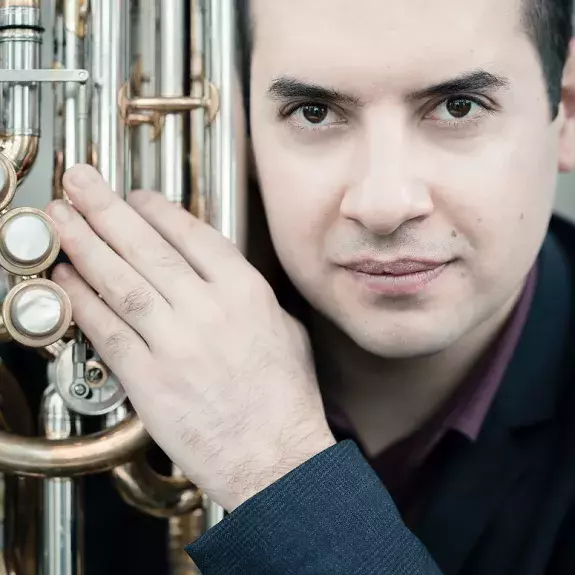
One of the most prominent tuba players of his generation, Ricardo Carvalhoso has built his career on a singing and energetic approach to brass playing, leading him to win jobs in several orchestras across Europe.
Since 2017 he is Principal Tuba of the Munich Philharmonie Orchestra. Prior to this engagement, Carvalhoso was Tuba-Solo of the Nice Philharmonie Orchestra and later he assumed the same position with the Orchestra of the Zurich Opera House Philharmonia Zurich.
His orchestral activity has led him to perform in some of the most important concert halls around the globe, including New York, Tokyo, Paris, London, Berlin and Vienna.
ln 2014 he played Vaughan Williams' Tuba Concerto with the Nice Philharmonie Orchestra under the direction of Walter Hilgers.
Between 2009 and 2011 he was awarded with a series of international prizes including the Young Musicians Award in Portugal, the "Aosta Valley" Brass Competition in ltaly, the Tuba Competition "Ville d'Avray" in France and the Music Prize of the Kiefer Hablitze\ Foundation in Switzerland. His musical education started in Portugal at the age of 14 years old and his first teachers included Juan Carlos Diaz, Chris Lee, Eduardo Nogeroles and Sergio Carolino. After graduating from Porto University of Music and Performing Arts, he pursued his Master Degree in Switzerland with Anne Je lie Visser.
Ricardo Carvalhoso plays Yamaha instruments and is a sought-after pedagogue and soloist.
Learn more about Ricardo Carvalhoso
Stefan
Legee
Professor of Sackbut
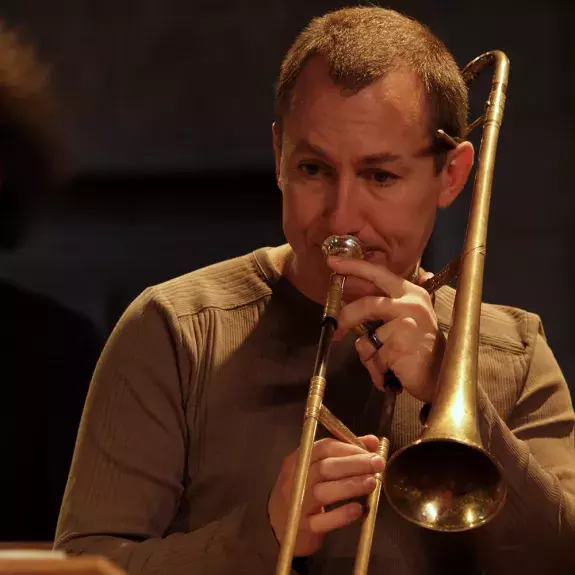
Stefan Legée began studying trombone in Reims with Amédé Grivillers before entering the Conservatoire National Supérieur de Musique de Paris, where he obtained a first prize in trombone unanimously. He received the Certificate of Aptitude in trombone in 1985 and won third prize at the International Competition in Prague in 1987. A member of the brass quintet Magnifica from 1985 to 1990, he won several international prizes with this ensemble (Baltimore and Narbonne). In 1996, he obtained a certificate of advanced studies in sackbut with high honors at the CNSM of Lyon.
From 1985 to 2006, Stefan Legée was the solo trombone of the Orchestre Colonne. He regularly performs with the Concerto Vocale conducted by René Jacobs, Hespérion XXI led by Jordi Savall, Europa Galante under Fabio Biondi, La Fenice by Jean Tubéry, the Sacqueboutiers de Toulouse, and the Concert Brisé led by William Dongois. He is also actively involved in contemporary music, playing with ensembles such as Erwartung (Bernard Desgraupes), Sine Qua Non (Nicolas Brochot), and Ars Nova (Philippe Nahon). In 1996, he premiered Dominique Probst's concerto for trombone and string orchestra, which was dedicated to him. He participated in concerts with Ensemble 2e2m from 2002 to 2005.
Numerous recordings document his work. These include Ex Libris with La Fenice on Opus 111, L’âge d’or du cornet with the Concert Brisé and William Dongois on K 617, the Passione di Jesù by Caldara with Fabio Biondi for Virgin Veritas, and a monograph on Philippe Hersant with Ensemble Ader for Musique Française d’Aujourd’hui.
Stefan Legée has given numerous masterclasses in sackbut. He teaches trombone and sackbut at the Conservatoire à Rayonnement Régional de Saint Maur and sackbut at the Haute école de musique de Genève.
Learn more about Stefan Legée.