Sarah
Verrue
Professeure of harp - chamber music with harp
Belgian harpist Sarah Verrue made a name for herself early on as a prize winner at the Dutch International Harp Competition, the Rotary Competition, the UFAM and the Martine Geliot Competition. At the age of 24, she became principal harpist of the Zurich Tonhalle Orchestra under the baton of Paavo Järvi. Since 2019, she has been guest harpist with the Lucerne Festival Orchestra.
Sarah holds a Master's degree in music and chamber music from the Conservatoire National Supérieur de Paris under the direction of Isabelle Moretti. She was a member of the Munich National Opera Academy in 2012 and, a year later, she took classes with Marie-Pierre Langlamet and played at the Karajan Academy of the Berliner Philharmoniker.
Sarah has performed as a chamber musician at renowned festivals such as the Festival d'Aix-en-Provence, the Schleswig-Holstein Music Festival, the Salzburg Festival, the MDR Musiksommer, the Festival van Vlaanderen and the Festival de Menton.
As a soloist, Sarah has performed with the Munich Chamber Orchestra, the Nieuwe Philharmonie Utrecht, the Graubünden Chamber Orchestra and the Cannes Symphony Orchestra.
Sarah has often worked in musical theatre at the Philharmonie du Luxembourg, in productions such as Cendrillon and Wolkenwanderer. In Zurich, she is involved in specialised schools for children with disabilities. In the summer, she is a coach at the Verbier Festival Orchestra, where she teaches and supports young musicians.
Joshua
Hyde
Professor of Saxophone - Chamber Music with Saxophone - Contemporary Chamber Music
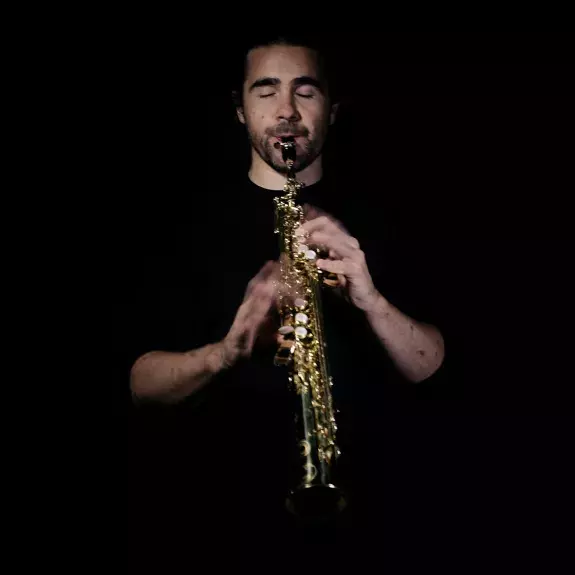
Joshua Hyde is a saxophonist, improviser, and composer.
Internationally recognized as a contemporary music performer, he is the co-artistic director and saxophonist of the Paris-based ensemble soundinitiative and a member of the duo scapegoat with Canadian percussionist Noam Bierstone. He is also a member of Australia's leading contemporary music ensemble, Elision, and is frequently invited to perform with major European ensembles such as Klangforum Wien, Musikfabrik, Ensemble Nadar, and Ensemble Intercontemporain.
Joshua has recorded with Kairos, Integrated Records, NMC, HCR, Wergo, and Torpor Vigil. His collaborations with composers worldwide have resulted in a long list of premieres. Comfortable in the world of improvisation, his latest album on Integrated Records, Sol, features a series of improvised reflections.
Particularly interested in creating immersive performance contexts, his compositions often incorporate his own videos and visual arts. In 2018, the New Thread Quartet premiered Bring mir einen Engel zurück at the DiMenna Center in New York City, and in 2017, part of his Vertical Horizons series was premiered by the ensemble Son d'Arte at Casa da Música in Porto.
Joshua has been invited to perform and teach at universities worldwide, including Harvard, Oxford, and Stanford. He is also part of the artistic leadership team of the Asia Pacific Saxophone Academy. In 2011, he won the First Prize and the Audience Prize at the 3rd Jean-Marie Londeix International Saxophone Competition, and in 2014, he was a laureate of the Kranichsteiner Musikpreis at the Darmstädter Ferienkurse.
A graduate of the Conservatoire National Supérieur de Musique et de Danse de Paris in saxophone (class of Claude Delangle), chamber music (class of Hae-Sun Kang and Frédéric Stochl), and generative improvisation (class of Vincent LeQuang and Alexandros Markeas), he also studied at the CRR de Bordeaux (class of Marie-Bernadette Charrier), CRR de Versailles (class of Vincent David), and the Victorian College of the Arts in Melbourne (classes of Barry Cockroft and Ian Godfrey).
Learn more about Joshua Hyde.
Nina
Uhari
Head of Vocal Department - Professor of Piano Accompaniment - Chamber Music with Piano
Born in Finland, Nina Uhari pursued professional piano studies at the Sibelius Academy in Helsinki under the guidance of Matti Raekallio and Eero Heinonen. She furthered her training in Baltimore, USA, with Julian Martin, and later in Paris with Bernard Ringeissen. Additionally, she studied accompaniment at the Conservatoire National de Région in Rueil-Malmaison.
Following her studies, Nina Uhari worked as a conductor at CNIPAL (Centre National d'Insertion pour des Artistes Lyriques) in Marseille from 2003 to 2012, where she became the principal conductor in 2008. Concurrently, she was a member of the opera role class at the Ecole Normale de Musique de Paris.
In September 2012, Nina Uhari joined the HEM (Haute Ecole de Musique) in Geneva as a vocal coach for the singing classes at the Neuchâtel and Geneva sites. She has performed in recitals and opera productions in Finland and France, including at the MIDEM Festival, Chorégies d'Orange, Théâtre du Châtelet, Festival de Radio France et Montpellier, Festival d'Aix en Provence, and various French opera houses. Her international performances have taken her to Germany, Austria, Spain, Colombia, Togo, and the United States. She has been invited to accompany master classes with renowned artists such as Tom Krause, Yvonne Minton, Mady Mesplé, Regina Werner, and Janine Reiss.
Learn more about Nina Uhari.
Philippe
Spiesser
Professor of Percussion - Chamber Music with Percussion - Coordinator of the Percussion Class
More than just a percussionist, Philippe Spiesser is an atypical and captivating musician. Coming from a family of musicians, he studied percussion at the Conservatoire de Musique de Strasbourg. Winner of the European Young Talents Competition in 1997, he has continually evolved by embracing new experiences and collaborating with creators from diverse backgrounds.
A universally recognized pedagogue, Philippe Spiesser has been a professor of percussion and coordinator of the percussion class at the Haute école de musique de Genève (HEM) since 2009. Previously, he taught at the Alfonso X University in Madrid, the Conservatorio Superior de Música de Palma de Mallorca, and the Conservatoire National de Région de Perpignan. He gives numerous masterclasses around the world: Juilliard School in New York, McGill in Montreal, Royal Academy of Music in London, Esmuc in Barcelona, Royal Conservatory in Brussels, Santa Cecilia in Rome, Musikhochschulen in Stuttgart, Mannheim, and Karlsruhe, CNSMDP in Paris, China Conservatory and Central Conservatory in Beijing, Superior Conservatories in Shanghai, Shenyang, and Dalian, Hong Kong University of Music, Lima University of Music, and Izmir University of Music.
Since 2012, Philippe Spiesser has led several research projects on new musical technologies and gesture capture, such as the GeKiPe project developed at HEM in partnership with IRCAM Centre Pompidou in Paris and the Ensemble Flashback. Through this work, he is the dedicatee and performer of numerous immersive and multimedia shows written for this gesture capture tool. In 2022, he created "Virtualis," the new concerto for solo percussion, ensemble, video, and gesture capture using the Gestrument tool, invented and developed by Jesper Nordin. His research has also led him to work with the Centro Ricerche Musicali in Rome, where he developed a solo repertoire with two acoustic instruments, the SkinAct and the Feed Drum, treated electronically and invented by Michelangelo Lupone.
A polymorphic musician, he performs worldwide in numerous international festivals such as Electronic Music Week in Shanghai, Percussion Festival in Beijing, Música in Lima, Arte Scienza and RomaEuropa in Rome, Ars Musica in Brussels, Musica in Strasbourg, Présences in Paris, Ritmo Vital in Madrid, Gaida Festival in Vilnius, Italy PAS in Pescara, CERN Festival and Archipel in Geneva, Aujourd’hui Musiques in Perpignan, Memmix in Palma de Mallorca, Ponte in Ulm, and Frequenz in Kiel, where he promotes new repertoire and creations by Ph. Hurel, P. Jodlowski, J. Nordin, A. Schubert, M. Matalon, B. Mantovani, Ph. Manoury, B. Letort, K. Narita, JM. Lopez Lopez, M. Lupone, and A. Vert. Philippe Spiesser is also invited to perform as a soloist with orchestras such as Lemanic Modern Ensemble, Norbotten NEO, Strasbourg Philharmonic Orchestra, Camerata de France, Beijing Symphony Orchestra, and Shenyang Symphony Orchestra.
He serves as a jury member for numerous international competitions, including Shanghai IPEA, Beijing PAS, Palma IMC, Italy PAS, and was the president of the jury for the International Geneva Competition in 2019.
Learn more about Philippe Spiesser
Pierre
Goy
Professor of Fortepiano, Clavichord, and Historical Keyboards
Pierre Goy studied piano with Fausto Zadra, Edith Murano, Esther Yellin, and Vlado Perlemuter, and attended masterclasses with Jörg Demus and Nikita Magaloff. A laureate of several competitions, he has performed concerts in Europe and the United States. Passionate about the expressive possibilities of historical instruments, he attended seminars by Paul Badura-Skoda and Jesper Christensen on rubato.
Pierre Goy strives to render the music of each era with the corresponding instrument. He forms a duo with Nicole Hostettler, performing on two fortepianos, the harpsichord and fortepiano, or two clavichords. They recorded the keyboard works of J. G. Müthel (Cantando 2016). He also recorded Liszt's "Années de Pèlerinage: Première année: Suisse" on a Richard Lipp piano from 1870 (Cantando 9814). For the Lyrinx Srumenti label (LYR 247), he recorded Chopin's early works on a replica of an 1826 Graf fortepiano, a recording unanimously praised by critics (five Diapasons, a Coup de cœur - Revue du son). His recording "Claviers mozartiens" (LYR 2251) won a Diapason d’or, a Coup de cœur, and an Opus d’or – Opus Haute Définition. Recently, with Nicole Hostettler, he recorded the two-keyboard works of Armand Louis Couperin on the Taskin fortepiano and the Ruckers-Taskin harpsichord at the Musée de la Musique.
In chamber music, he collaborates with members of "Il Giardino Armonico," the Quatuor Mosaïques, and the Ensemble Baroque de Limoges. He has published various articles on performance practice and instrument making.
Pierre Goy is the instigator of the Rencontres Internationales Harmoniques de Lausanne, which has gathered instrument makers, musicians, musicologists, and museum curators around historical instruments every two years since 2002.
Learn more about Pierre Goy.
Charlotte
Perrey Beaude
Professor of Writing Practice - Cadence Writing - Music Theory
Charlotte Perrey began her musical studies with piano, quickly developing a strong inclination for improvisation and composition.
After studying in advanced mathematics classes, she fully devoted herself to music and specialized in writing under the guidance of Stéphane Delplace. She continued her studies at the Conservatoire National Supérieur de Paris, where she earned First Prizes in Harmony, Counterpoint, 20th-21st Century Writing, Fugue and Forms, as well as the Marcel Dautremer Prize. She studied notably with Jean-François Zygel, Thierry Escaich, and Marc-André Dalbavie.
She currently teaches at the Haute école de musique de Lausanne and the Haute école de musique de Genève.
Aline
Champion
Professor of Violin
Aline Champion was accepted into the Haute Ecole de Musique of Geneva at the age of 12, thus becoming the youngest student admitted, a record which stands to this day. The same year she made her solo debut at the Victoria Hall in Geneva, which marked the start of her career.
She continued her studies with teachers such as Tibor Varga and Pierre Amoyal before joining Philipp Hirschhorn’s class at the Utrecht Conservatory in the Netherlands, finishing her studies with Viktor Libermann. She graduated with distinctions. Throughout her studies, Aline has had the privilege to work with artists such as Yehudi Menuhin, Sandor Vegh, Nathan Milstein and Itzahk Perlmann, all of whom have influenced her notably.
Aline has been invited in some of the most prestigious concert halls, including the Royal Albert Hall in Londres, the Auditorio Nacional in Madrid, the Philharmonie in Berlin, the Tonhalle in Zürich as well as the KKL in Lucerne. She has also performed at the Lucerne Festival, at the Mostly Haydn Festival in London and the Easter Festival in Baden-Baden. Passionate about chamber music, she has collaborated with Murray Perahia, Tibor Varga, Katia et Marielle Labèque, Emmanuel Pahud, Marie-Pierre Langlamet, Christian Poltera, Baiba et Lauma Skride, Markus Groh, Wolfram Christ and Peter Ustinov.
Alongside her career as a solo artist, she became the concertmaster of the Cologne Radio Symphony Orchestra before joining the 1st violins of the Berlin Philharmonic Orchestra in 2000. Aline graduated as a psychotherapist (HP) in 2017, specializing in Performance Coaching. She developed her own method tailored for musicians, blending her stage experience with knowledge drawn from neuroscience, sports, and the business world. Her close collaboration with Jean-Pierre Egger, coach to numerous world and Olympic champions, has greatly enriched her perspective. Since 2018, she has been regularly leading conferences and seminars for musicians, where she explores key topics such as work organization, stage fright management, concentration, motivational strategies, confidence building, and the development and mastery of stage presence,
providing comprehensive support.
As pedagogue, she has been teaching at the Music University in Geneva since 2018. She was a tutor for several years at the Schleswig Holstein Orchestra Academy Festival, and is regularly invited to give masterclasses in France, Switzerland, the United States, Italy, Singapore and China.
In 2005, she was honored by University of Shanghai with the title of Professor Honoris Causa, and in 2011, she was named Professor of Christchurch University in New-Zealand. Aline was also awarded an honorary citizenship by the municipality of Plan-les-Ouates, Geneva, in Switzerland.
In 2022, she created in 2022 the Villars Music Academy, pioneering a holistic approach to music making, in collaboration with world-class musicians and speakers, where she is the Director.
Learn more about Aline Champion.
Bruno
Cocset
Professor of Cello
Born in 1963, Bruno Cocset graduated from the Conservatoire National de Région de Tours. He was admitted to the Conservatoire National Supérieur de Musique de Lyon in 1980, where he studied with Alain Meunier, and later with Jean Deplace, leaving his class in March 1983 due to stylistic differences.
He approached the baroque cello and gut string playing as an autodidact and later with Christophe Coin, becoming the first graduate of his class at the Conservatoire National Supérieur de Musique et Danse de Paris (First Prize with unanimous distinction in 1986). He also attended masterclasses by cellist Anner Bijlsma and violinist Jaap Schroeder.
Twenty years of rich experiences and musical collaborations followed: Les Arts Florissants, Mosaïques, Fitzwilliam, Ensemble Baroque de Limoges, Le Concert Français, La Petite Bande, Les Musiciens du Louvre, Les Talens Lyriques, Arsys, Ricercar Consort, l’Arpeggiata, Stradivaria, l’Amoroso, Al Ayre Español, Henri Ledroit, Véronique Gens, Maurice Bourgue, Franz Brüggen, Gustav Leonhardt, Jos Van Immerseel, Jean-Claude Malgoire, Philippe Herreweghe…
His most faithful affiliations are with Il Seminario Musicale by Gérard Lesne (1988-2004), and the Concert des Nations and Hesperion XX-XXI by Jordi Savall (1990-2005). In 1996, he founded Les Basses Réunies and self-produced his first solo recording: the sonatas of Antonio Vivaldi. This disc, welcomed by the Alpha label, received the Vivaldi prize from the Cini Foundation in Venice. About ten other recordings, praised by French and international music critics, led to regular invitations to perform in France, Europe, Quebec, and Russia.
Each of these recording projects is linked to a sound and organological research collaboration with luthier Charles Riché. Nine instruments have emerged from this collaboration. As a musician-researcher, he thus offers a "plural" cello. He is now exclusively dedicated to this path and to teaching. In September 2005, he was appointed Professor of Baroque Cello at the Haute école de musique de Genève.
Learn more about Bruno Cocset.
Tedi
Papavrami
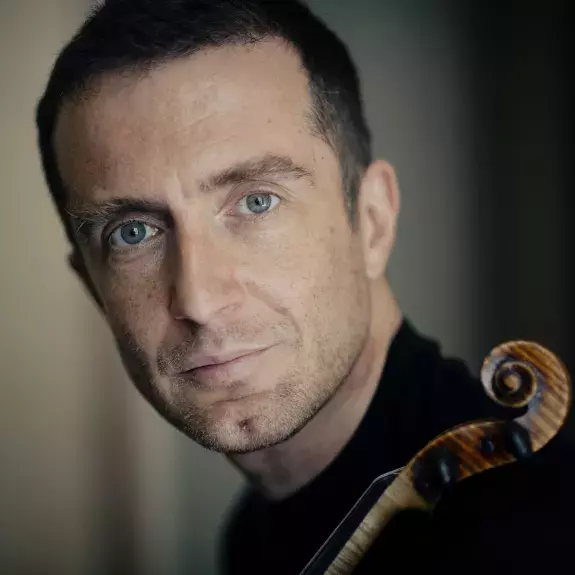
Professor of Violin
Arriving at a very young age in France, Tedi Papavrami discovered a country and culture that were completely foreign to him. His natural curiosity and the need to master the French language in order to make this country his own, along with initial great solitude, drove him to devour books, always in French: Stendhal, Proust, Flaubert, Dostoevsky, Chekhov, Kafka... This curiosity beyond borders, combined with intellectual and artistic demands, allowed him to bridge the gap between his original domain and other horizons, making him a rare interpreter in the musical world.
Thus, in 2000, after the passing of Albanian translator J. Vrioni, he naturally took up the mantle of translating the works of Ismaïl Kadaré, whom he had known as a child in Albania. This foray into the literary world also became a way for him to "professionally exist for the first time outside of the violin." In 2013, he continued this journey with the writing of "Fugue pour Violon Seul" published by Robert Laffont. Unanimously praised by the press, this autobiographical account narrates his journey as a child prodigy in Albania and his passage to the West, towards freedom.
However, this diversification would not have been possible without an early and singular focus on the violin from his young years. The instrument, which had always been a part of his life, was introduced to him at the age of 5 by his father, a brilliant professor with extensive pedagogical experience. Tedi's progress was rapid: three years later, he performed Sarasate's "Zigeunerweisen" with an orchestra. At eleven, he publicly performed Paganini's Concerto No. 1 with the formidable Sauret cadenza.
In 1982 in Albania, a country cut off from the world, he was noticed by flutist Alain Marion who arranged for him to be invited to Paris as a French government scholarship student. He then studied with Pierre Amoyal at the C.N.S.M in Paris for four years.
At the end of his studies, at the age of 15, Tedi pursued his musical and instrumental development independently. Shortly before, with his parents, he fled the communist regime in Albania to settle with them in France. Severe sanctions were imposed in retaliation on the rest of the family remaining in Albania, lasting until the fall of the communist regime in 1991. Tedi and his parents left Paris to avoid being within reach of Albanian embassy officials searching for them and settled near Bordeaux.
Benefiting from several awards, T. Papavrami began a career as a soloist and chamber musician from the 1990s onwards. He has since collaborated as a soloist with conductors such as K. Sanderling, A. Jordan, E. Krivine, M. Honeck, F.X. Roth, Th. Fischer, G. Varga, M. Aeschenbacher… In chamber music, he was a member of the Schumann Quartet, a piano quartet, for 9 years, and he performs in concert or on recordings with partners such as Philippe Bianconi, Gary Hoffman, Marc Coppey, Nelson Goerner, Martha Argerich, Maria Joao Pires, Viktoria Mullova, Paul Meyer, and Lawrence Power.
Now based in Geneva, Switzerland, Tedi holds a position as Professor of Violin at the HEM. He plays on a violin made in 2022 for him by luthier David Leonard Wiedmer.
Learn more about Tedi Papavrami
Alessio
Corti
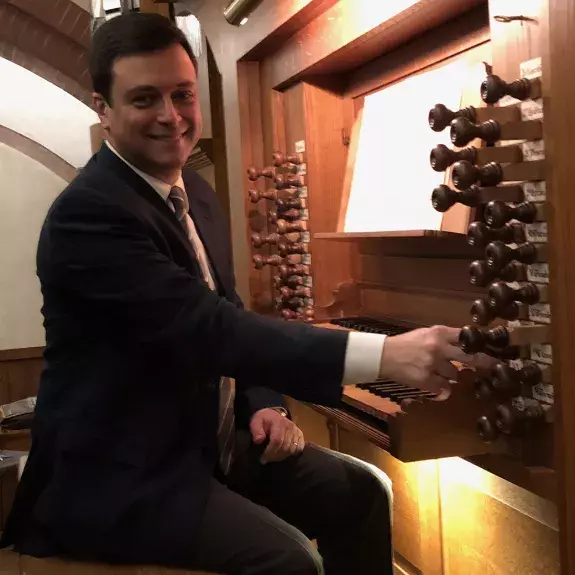
Professor of Organ - Improvisation (for Organists) - Chamber Music with Organ - Organ as a Secondary Instrument
Born in Milan in 1967, the son of a renowned organist and pedagogue, Alessio Corti received his first music lessons at an early age.
In 1985, he obtained his piano diploma "cum laude," followed by diplomas in organ and harpsichord.
He pursued further studies with internationally renowned organists and was a student of Lionel Rogg at the Conservatoire Supérieur de Genève for three years. In 1992, he won a "Premier Prix de Virtuosité with distinction" and the special "Otto Barblan" prize.
He subsequently won First Prizes at the International Competitions of Geneva (C.I.E.M. 1993), Carouge (Switzerland), and the "Froberger Prize" for early music at the International Competition of Kaltern-SüdTyrol. He is also a laureate of several competitions in Italy, notably in Milan.
In 1983, he was appointed titular organist of the Grands-Orgues at the Church of Santa Maria Segreta in Milan, where at the age of 18, he performed the Complete Works of D. Buxtehude, and the following year, the Complete Works of J.S. Bach. From 1991 to 2016, he was also the titular organist at the Chiesa Cristiana Protestante in Milan.
In his brilliant career, he is regularly invited to major international organ festivals.
Alessio Corti plays a wide repertoire of early, romantic, and contemporary music, and his discography comprises around thirty CDs, including a complete recording of J.S. Bach’s organ works and "The Art of Fugue," monographs of W.A. Mozart and Mendelssohn, and several anthologies on historic organs. For the Fugatto label, he recorded a DVD of J.S. Bach's Six Trio Sonatas on the historic (1738) organ of the Kreuzkirche in Suhl, Thuringia.
His recordings and recitals have received attention and favorable reviews from international critics.
He is often invited as a jury member for major international competitions and to give masterclasses.
From 1994 to 2001, he was a professor of organ in Italy at the Conservatories of Udine and Verona, having placed first in the national competition of the Ministry of Public Education.
Alessio Corti has been a Professor of Organ and Improvisation at the Haute école de musique de Genève since 2001, succeeding Lionel Rogg. Many of his students have obtained diplomas and master's degrees (concert, soloist, pedagogy), and some have distinguished themselves in international competitions.
Learn more about Alessio Corti.