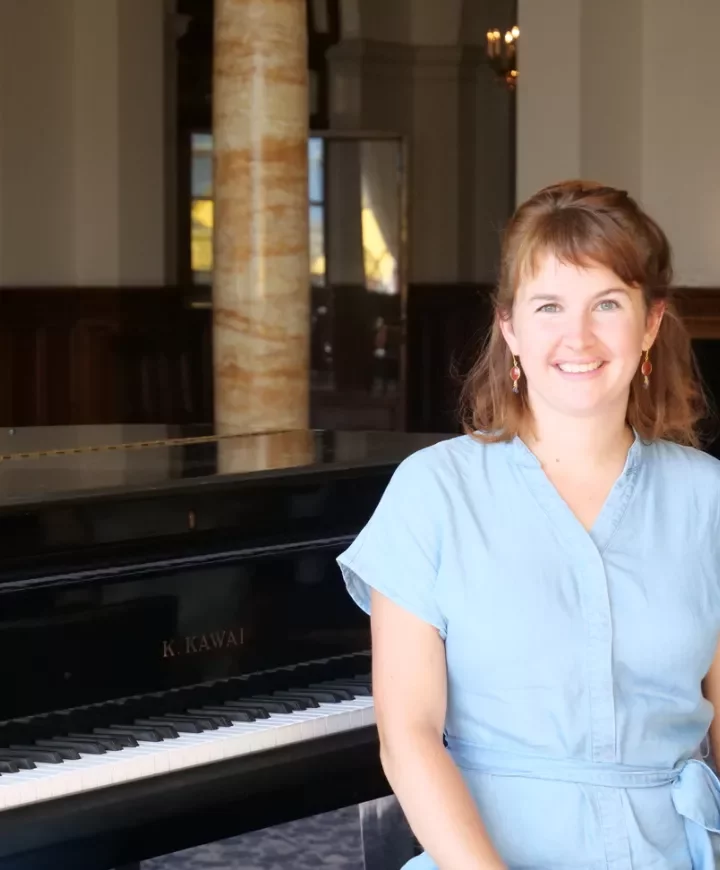
Charlotte Graber, musician and librarian
Tell us a little about yourself: where you’re from, what led you to music…
I was born in the Neuchâtel mountains and returned there as soon as I finished my studies. My grandmother was a pianist and my aunt a singer; as for me, I started playing the piano at 5, and music has always been a natural part of my life. Around 12, I started writing songs and accompanying myself on guitar and piano. These two paths—classical piano and songwriting—developed in parallel for many years.
It was at the Lycée de La Chaux-de-Fonds that music became even more, with my decision to dedicate my studies to it and, later, my career.
I have always loved all facets of music, and particularly interdisciplinary topics—gender equality, animal sounds, the link between music and health, music as a social phenomenon, sound as cultural heritage, and so on. I therefore never wanted to dedicate my professional life solely to musical performance, but rather to adopt a holistic approach that would also allow me to earn a living.
What degree programs did you complete? What was your academic experience like?
I earned a Bachelor’s degree in “Music and Musicology” at the HEM and the University of Geneva. As my interest in musicology grew, I went on to pursue a Master’s degree in musicology, also in Geneva, focusing specifically on the topic of birdsong in my Master’s thesis.
Afterward, I completed the CAS in Cultural and Music Project Management at the HEM (Neuchâtel campus), while also working at the Montreux Jazz Festival archives at EPFL, where I happily worked for seven years.
I fully embraced my student life in Geneva during my Bachelor’s degree, while also having the opportunity to develop my own musical project on the side and forge friendships—at the HEM, the University, or within Geneva’s cultural scene—that continue to this day and have been instrumental in shaping my identity and career path.
Where are you in your career? What is your daily life as an artist like? How do you balance your time?
My life right now revolves around my part-time (50%) position as a librarian at the Geneva University of Music, at the Neuchâtel campus, as well as providing guidance and expertise for academic projects at the Lausanne University of Music.
Music has always played a major role in my life, especially in the realm of contemporary music, up until the onset of the pandemic and the start of my life as a mother. It remains a part of my life, but in a more intimate way, particularly through playing music with my two sons and my partner.
I also taught piano for ten years alongside my other activities, but three years ago, I chose to focus more on the field of music archives and libraries, where I have worked since my studies. I have always wanted a professional life balanced between a stable job, personal projects, and mentoring, and I am grateful to have been able to achieve this so far. I’m also lucky to have free time to go running or skiing, spend time with my loved ones, and enjoy nature—all of which are essential to my well-being.
Looking back, what were the key factors that helped you—or continue to help you—in your professional and artistic life?
Intensive practice of an instrument taught me how to work independently, as well as the importance of structure and goals. These lessons have been essential in all the activities—musical and non-musical—that I have undertaken since then.
Another aspect that I find essential is the people I’ve met and the opportunities that have arisen during my studies and beyond. In my opinion, it is through these encounters that the projects, curiosity, and open-mindedness necessary for professional and personal growth emerge.
The opportunity to complete internships during my Master’s in musicology was also decisive. These forays into the professional world allowed me to confirm my interests in the fields of archives and libraries, as well as in the transmission and research of knowledge.
On the contrary, are there things you wish you’d known, or that you felt were missing when you finished your studies?
Knowing that there’s a time for everything, and not trying to do everything at once, would have been very helpful in conserving my energy and avoiding the exhaustion I experienced after my bachelor’s degree. That being said, I don’t regret my years of study at all. I was able to enjoy a very stimulating and exciting environment.
The importance of being proactive and building a network from the very start of your studies also seems fundamental to me in the music industry, because these opportunities don’t necessarily come around again later, and music institutions are an extremely fertile ground for ideas and energy.
See more about the diplomas
Bachelor of Arts in music and musicology UNIGE - Musicology Department CAS in the management of cultural and musical projects