Talia
Bachir-Loopuyt
Head of the Ethnomusicology Program - Professor of Ethnomusicology
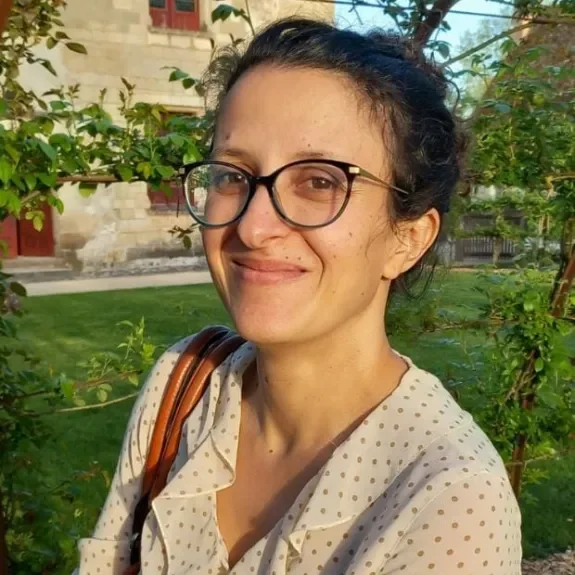
Talia Bachir-Loopuyt is an ethnomusicologist and anthropologist specialising in the music of the Maghreb and the Middle East (in particular Turkey), and studying its dissemination and transmission in Europe (Germany, France, Switzerland). She trained in Germanic Studies at the École Normale Supérieure in Lyon (leading to the Agrégation, 2004), while also studying oriental music (oud, kementche, modal improvisation) at the École Nationale de Musique in Villeurbanne and in Turkey.
Her dissertation, written under the joint supervision of EHESS Paris and Humboldt University (Berlin), focused on world music festivals and the ideal of a plural society in Germany. As a post-doctoral researcher (University of Saint-Etienne, University of Lausanne), she worked on the dissemination of Turkish music in France and on the visibility of Islam, while pursuing work on the history of ethnomusicology, child musicians and music in plural societies.
Since 2016, she has been a senior lecturer at Tours, where she contributed in particular to the creation of the Master Music and Human Sciences (with the University of Poitiers). Involved in several academic organisations (SFE, IMS, ICTM) and journal committees, she is also co-director of the Haizebegi festival in Bayonne and a member of the scientific board of the CMTRA - Ethnopôle Musique, territoires, interculturalité.
Nicolas
Bolens
Professor of Counterpoint, 20th-Century Writing, and Practical Writing
En associant traditions et explorations nouvelles des matières sonores, les œuvres de Nicolas Bolens investissent l’espace en valorisant les éléments et les sujets qui se présentent à lui.
Combining traditions and new explorations of sound materials, the works of Nicolas Bolens invest in space by enhancing the elements and subjects that present themselves to him.
His music is regularly connected to other elements: texts, films, places, evocations... In each context, he seeks an authentic dramaturgy that promotes unprecedented settings.
For example, with the Batida ensemble, he imagined "Welcome to the Castle" (2017), three musical acts for musicians moving through the Allymes Castle near Amberieu-en-Bugey.
For the Gémeau Quartet, he wrote "La Ville Oblique" (2013), a string quartet conceived as a musical extension of the short film "Un Chien Andalou" by Dalí and Buñuel.
Written words, most often poetic, permeate his entire production. He has composed on poems by Celan, Sachs, Mallarmé, Char, Blok, Khayyam, Michaux, Éluard, Basho, Neruda, Rilke, Adonis, Shakespeare... These authors, from various times and origins, have led him to integrate many languages into his works, considering their sonic as well as semantic potentials.
Orchestration also holds an important place in his work, rethinking the instrumentation of certain past works. In 2018, he re-orchestrated "Lieder eines fahrenden Gesellen" and the 4th Symphony by Gustav Mahler for the Lemanic Modern Ensemble under the direction of conductor Pierre Bleuse.
Commissioned by the association Ouverture Opera, his recent rewriting of Mozart's "The Magic Flute" follows the same approach.
Nicolas Bolens has notably collaborated with the Batida ensemble, the Lemanic Modern Ensemble, the Swiss Chamber Soloists, the Ensemble Vocal de Lausanne, the Ensemble Vocal Polhymnia, the Ensemble Vortex, the Basler Madrigalisten, and the Ensemble Vocal Séquence...
Born in Geneva, he first studied piano at the Conservatoire de musique de Genève, then completed his training in the composition class of Jean Balissat. He further honed his skills with Rudolph Kelterborn, Klaus Huber, Edison Denisov, and Eric Gaudibert. He is the recipient of numerous composition prizes, including those from the Orchestre de Chambre de Lausanne (1993) and the Banque Cantonale Neuchâteloise (2002), as well as a scholarship from the Leenaards Foundation (1998).
An engaged pedagogue and artist, he teaches counterpoint, 20th-century writing, and composition at the Haute école de musique de Genève, where he has been the head of the Composition and Theory Department from 2015 to 2024. He is also involved in several institutions related to musical creation in Switzerland, including the Swiss Musicians Association, the Archipel Festival Association, the Nicati-de-Luze Foundation, and the Artistic Council of the Geneva Competition.
Learn more about Nicolas Bolens
Moudja
Cugno
Coordinateur Master musique à l'école / Maître d'enseignement en Transcréations
Moudja Cugno est musicien, auteur, compositeur, interprète, ingénieur du son et pédagogue. Pianiste, guitariste et chanteur, il développe une pratique artistique plurielle, nourrie par la création, la production musicale et la scène.
Cette expérience artistique et technique constitue le socle de son engagement pédagogique. Titulaire d’un Bachelor et de deux Masters en pédagogie musicale, il enseigne depuis plus de vingt-cinq ans, dont douze années au sein du Département de l’Instruction publique à Genève.
En 2025, il est nommé maître d’enseignement en transcréation à la Haute école de musique de Genève et devient coordinateur de la filière Master Musique à l’école. Il y conduit une réflexion de fond sur la formation des futur·e·s enseignant·e·s, articulant pratique artistique, ingénierie du son, outils numériques, pédagogie et réalités du terrain scolaire.
Son travail s’inscrit dans une perspective plus large de défense de la place de la musique dans l’école et dans la société, et accorde une importance centrale à la construction de l’identité professionnelle de l’enseignant·e de musique, dans ses dimensions artistique, pédagogique, éthique et humaine.
Il est également mandaté pour une mission de concertation avec l’IUFE, visant à aligner les référentiels de compétences et les contenus de formation entre les deux institutions.
Il mène actuellement un travail de recherche sur les dimensions sensibles et transformatrices de l’éducation musicale, à la croisée des pratiques artistiques, des sciences de l’éducation et des enjeux contemporains. Il a été publié dans une revue universitaire, nommé pour un prix de pédagogie à la HEP Vaud, et participe au groupe de travail sur l’intelligence artificielle en éducation mandaté par la DGEO.
Patrik Vincent
Dasen
Professor of Ethnomusicology, Master’s Research Seminar, World Music Workshop
Patrik Dasen graduated in ethnomusicology from the Université Paris X Nanterre (Maîtrise, 1999) and the Université de Nice Sophia-Antipolis (Master 2, 2009), where he also completed a doctoral thesis in March 2020 entitled "Becoming and Being a Maker of Irish Bagpipes Uilleann Pipes: Between Deterritorialization and Heritage Preservation," under the supervision of Prof. Luc Charles-Dominique. His research focuses on the processes of transmission and heritage preservation of musical traditions.
He worked for ten years at the Ateliers d'ethnomusicologie de Genève as the head of educational activities and public relations. He also led, with a small team, the cataloging and digitization campaign of the Archives Internationales de Musique Populaire (AIMP, 2005-2011) by Constantin Brailoiu, which are now fully accessible at the Musée d'ethnographie de Genève thanks to this preservation effort. He has been teaching ethnomusicology and the sociology of contemporary music at the Haute école de musique de Genève since 2008.
Learn more about Patrik Vincent Dasen
Charlotte
Perrey Beaude
Professor of Writing Practice - Cadence Writing - Music Theory
Charlotte Perrey began her musical studies with piano, quickly developing a strong inclination for improvisation and composition.
After studying in advanced mathematics classes, she fully devoted herself to music and specialized in writing under the guidance of Stéphane Delplace. She continued her studies at the Conservatoire National Supérieur de Paris, where she earned First Prizes in Harmony, Counterpoint, 20th-21st Century Writing, Fugue and Forms, as well as the Marcel Dautremer Prize. She studied notably with Jean-François Zygel, Thierry Escaich, and Marc-André Dalbavie.
She currently teaches at the Haute école de musique de Lausanne and the Haute école de musique de Genève.
Rodolphe
Schacher
Professor of Writing Practice - Analysis - Harmony - Counterpoint
Franco-Swiss composer and pianist Rodolphe Schacher was born in France in 1973. Schacher pursued his musical studies in Paris, Geneva, and Zurich, under the guidance of Michael Jarrell, Thierry Escaich, Gerald Bennett, and Ulrich Koella.
He has been awarded five first prizes (harmony, counterpoint, Renaissance counterpoint, fugue and forms, and 20th-century music) at the CNSM in Paris and received the composition and theory diploma with honors, as well as the concert diploma in chamber music from the Zurich University of the Arts.
Alongside his artistic activities, Schacher teaches analysis and writing at the Haute école de musique de Genève, writing at the Haute école de musique de Lausanne, and taught composition until June 2015 at the Zurich University of the Arts.
Antoine
Schneider
Professor of Practical Writing - Contrepoint
After studying violin and musicology in Geneva, Antoine Schneider furthered his musical theory education in Zurich with Burkhard Kinzler and Andreas Nick. He also trained in musical direction, piano, and baroque violin.
He is currently a professor of solfège and counterpoint at the Haute école de musique de Genève and the Haute école des arts de Berne, as well as a professor of musical training at the ESM Bourgogne-Franche-Comté (Early Music Department).
In his teaching, he specializes in the practices of musical improvisation during the Renaissance period. He is regularly invited to give masterclasses across Europe and collaborates with Jean-Yves Haymoz, Barnabé Janin (CNSMD Lyon), and the Helicona project. He is the co-responsible for the website Super librum cantare (www.superlibrum.com).
Carine
Tripet Lièvre
Responsible of pedagogical programs - Professor of Education Sciences
Holder of a PhD in Social and Political Sciences, specializing in Education Sciences, Carine Tripet is also a musician. Coming from a jazz background but specialized in world vocal music, she is active in Valais where her musical projects revolve around immigration issues and Valaisan heritage. She received the Musique Pro Valais cultural scholarship for the period 2014-2017 with her project ViaVallesia.
Formerly a professor at the Haute Ecole Pédagogique du Valais, where she led several programs, she also taught Applied Education Sciences in Music Education for six years at HEMU. The content of her courses is decidedly interdisciplinary, drawing from various relevant disciplines (including, but not limited to: didactics, sociology, developmental psychology, neuroscience, ethics, law), to establish a solid network of concepts and notions that enable young teachers to self-analyze their practice. Her research focuses on the construction of the professional identity of music teachers in connection with cultural democracy.
Since 2022, she has been coordinating the pedagogy program at the Haute Ecole de Musique de Genève.