Sébastien Brugière, a Look Back at the CAS in Cultural and Music Project Management
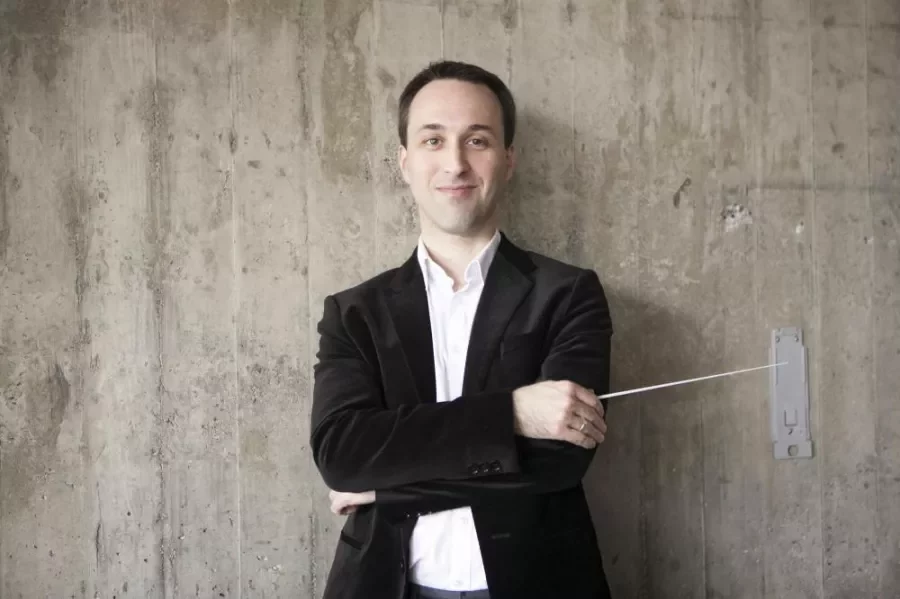
Since 2020, I have been working full-time at the Martin Bodmer Foundation as Head of Cultural Mediation and Research Associate. Before that, I led the life of a professional musician which, through various winding paths, gradually led me toward careers in culture and project management.
After arriving in Geneva in the early 2000s, I completed all my musical studies at HEM Geneva, where I obtained three Master’s degrees: in violin, music pedagogy, and orchestral conducting. For about ten years, I worked as a professional violinist in numerous orchestras, notably at the Lyon National Opera. After completing my Master’s in conducting, I was appointed Musical Director of the Orchestra and Choir of the University of Geneva. Conducting orchestras and choirs then became central to my professional life (up to around fifty concerts per year and several ensembles conducted simultaneously).
At the same time, I have always enjoyed initiating and building projects. I co-founded a music production company as well as several ensembles, including the Chamber Choir of the University of Geneva and the Versoix Chamber Orchestra, which I still conduct today.
I was therefore already very active in certain aspects of cultural management before beginning this program, particularly through creating ensembles, organizing concerts, coordinating artistic teams, and developing cultural projects.
I already had substantial hands-on experience in leading artistic projects, but I felt the need to strengthen certain more strategic and administrative aspects.
I completed this CAS in 2017–2018. My initial motivation was to acquire practical tools to better structure and develop a new ensemble I had created a few years earlier: Synopsie, a soloists’ ensemble dedicated to performing symphonic repertoire in reduced versions.
At that point in my career, I already had significant practical experience in managing artistic projects, but I felt the need to consolidate certain more strategic and administrative aspects: financial management, communication, team structuring, project development, and long-term vision.
I took advantage of the end of my mandate at the University of Geneva to undertake this training. It was something I had been considering for some time, but my particularly busy schedule had not allowed me to pursue it until then.
Some of the courses had a very concrete and immediate application in my professional practice, while others mainly opened up new perspectives for reflection.
The structure of the program was very well suited to my professional activity, particularly because it allowed me to combine training, personal reflection, and professional practice. But beyond the practical aspect, I believe I approached this program with a great deal of intellectual curiosity.
I never limited myself to the question: “Will this be immediately useful to me?” Experience has taught me that some learning reveals its importance much later, sometimes in unexpected contexts. When I was learning Latin in secondary school, I often heard that it would be useless. Yet it later proved extremely valuable in my work as a choir conductor, and now in my current role at the Martin Bodmer Foundation, where the relationship to texts, languages, and history of the book plays a central role.
I experienced the CAS in much the same way. Some courses had a very concrete and immediate application in my professional practice, while others mainly opened up new perspectivres for reflection. I am thinking in particular of the sociology course, led by a very inspiring professor, which nourished a line of reflection that I continue to pursue today. That is also what I appreciated about this program: it was not limited to technical tools but also encouraged stepping back and reflecting on the role of culture, institutions, and the projects we carry.
Through its various modules, the CAS allowed me to approach all aspects of cultural project management in a structured way, with strong complementarity between the different courses.
I was already quite confident in certain areas, particularly budget management, thanks to my experience. On the other hand, I learned a great deal about fundraising, partnership development, and more broadly about project structuring tools.
The more theoretical contributions related to project management also left a strong impression on me. They allowed me to take a step back from my practice, clarify certain working methods, and better articulate artistic vision, organization, and strategy. These are tools that I still use today in the various cultural projects I develop.
Cultural career paths are not always linear, and it is often at the crossroads of multiple experiences that the richest projects emerge.
As far as I am concerned, there was clearly a before and after the CAS. This program marked a real turning point in my professional path. At its conclusion, I took the opportunity to apply to the Grand Théâtre de Genève as a cultural mediator, and I was hired. This marked the beginning of a new stage in my professional life.
This position required both strong musical skills and a genuine ability to design, coordinate, and lead cultural projects. The CAS enabled me to acquire this dual legitimacy. I am not sure I would have obtained this position without this training, which demonstrated an additional competency alongside my background as a musician and opened up new professional perspectives.
Looking back, I realize that my career has been built step by step and through successive shifts: from violinist to orchestra and choir conductor, then from musician to cultural mediation in an opera house, before evolving into my current role as Head of Cultural Mediation in a museum dedicated to literary heritage and the written word.
Today, I feel a strong sense of balance between my work at the Bodmer Foundation, which deeply inspires me, and my artistic commitment as Musical Director of the Versoix Chamber Orchestra. These two worlds also feed each other, through shared projects but also through the research I conduct on the musical manuscripts held in the Bodmeriana collections.
This CAS also confirmed something important for me: cultural career paths are not always linear, and it is often at the intersection of multiple experiences that the richest projects are born. My background as a musician continues to inform my work in cultural mediation, just as my work in the museum world nourishes my artistic thinking. I value this circulation between disciplines, audiences, and ways of transmitting knowledge.