Maïté Louis, violonist
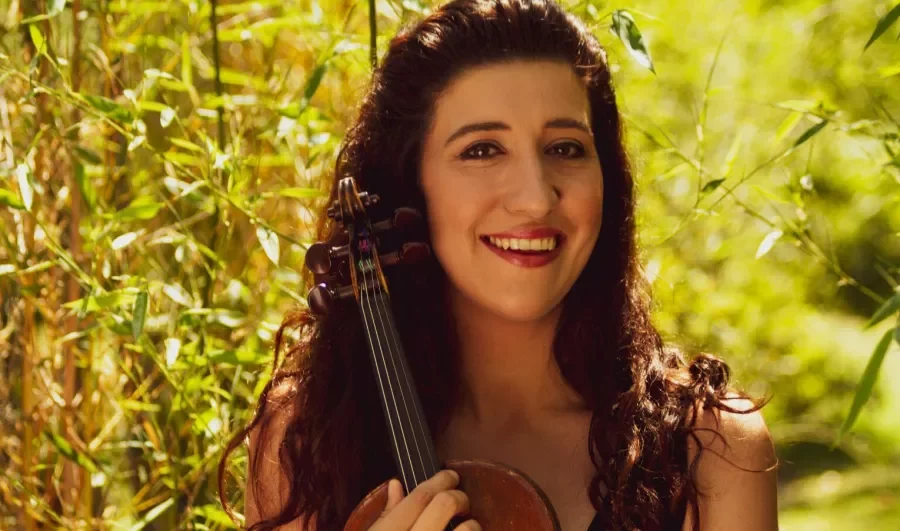
Introduce yourself in a few words: where do you come from, and what led you to music?
I have been a violinist for as long as my earliest memories reach. The violin has never been just one activity among others; it has always been a language, something self-evident, a way of being in the world.
I gave my first professional concerts at the age of nine and performed as a soloist with orchestra from the age of thirteen. Very early on, the stage became a natural space for me—almost an organic one.
Choosing it as a profession was never really a question. It was not about deciding whether music would be part of my life, but rather about understanding how I could dedicate my life to it, with rigor, commitment, and depth.
What course of study did you follow? What were your studies like for you?
My path has been somewhat unusual, as I never followed the traditional conservatory curriculum. Instead, my training alternated between private lessons, violin school, and masterclasses.
At thirteen, I entered the Haute École de Musique de Genève for a Bachelor’s degree in the class of Marie-Annick Nicolas, and later continued with a Master of Solo Performance with Jean-Pierre Wallez. At the same time, I had the opportunity to work regularly in masterclasses with Ivry Gitlis—an artistic encounter that left a deep impression on me, marked by immense freedom.
I deeply loved my years at the HEM. Although I was very young, I always felt supported with great kindness by the administration, the professors, and the other students. I was already giving many concerts while continuing my schooling in France; it required careful organization, but everything unfolded smoothly.
Looking back, I see this path as something almost tailor-made: both structured and free, demanding and profoundly human.
Where are you in your career today? What does your daily life as an artist look like?
I feel that I have reached a moment in my life where everything I have built since childhood has begun to form a kind of unity.
The stage remains the living center of my path. Playing as a soloist, carrying a program, stepping into the silence of a concert hall and sensing the shared tension that precedes the first note—this remains a deep necessity for me. Concerts punctuate my year, each one the culmination of a patient and often invisible process of work. It is a relationship with time, with maturation, that has also extended into my recordings with the Calliope label. The studio imposes a different truth from the stage—more exposed, more definitive. My recordings are traces of these periods of intense exploration, almost crystallizations.
Very naturally, this artistic journey has also been accompanied by a strong desire to transmit. Teaching in France and later at the Conservatoire populaire de Genève is not a peripheral activity; it is part of my balance. Guiding young musicians in the development of their artistic thinking, their autonomy, and their inner standards feels inseparable from my own work as a performer. Teaching forces one to clarify, deepen, and remain in motion. The books I have published with Éditions Delatour France were born from the same need: to put into words what years of study and stage experience have taught me, and to structure a reflection on gesture, sound, and presence.
In recent years, another field has opened up: the world of large companies. There, I speak about leadership, presence, and managing pressure—but at heart I am always speaking about the same things: responsibility, listening, and commitment. I do not feel that I have several professions; I simply apply the same principles in different contexts.
My daily life alternates between rehearsals, writing, pedagogical preparation, and travel. Over time, I have come to understand that artistic quality also depends on a broader balance: caring for the body as an instrument in its own right, nourishing the mind through culture and encounters, and preserving moments of silence and rest. A career is not a succession of events but an organic construction, requiring as much discipline as it does breathing space.
Looking back, what key elements helped you in your professional life?
International competitions were crucial moments. They confronted me with my limits, with pressure, and with constant comparison. I realized quite early on that I would not cross certain thresholds through tension or sheer will alone. I had to transform the way I worked: introducing more calm, more reflection, and a deeper awareness of gesture. Above all, I had to learn a form of kindness toward myself, without ever abandoning high standards.
The results I obtained were important, of course. But the real turning point was internal. It was by rediscovering stability and clarity that I was able to move forward.
And at the center of everything, there has always been joy.
The joy of playing, of entering into sound, of feeling the vibration unfold in a concert hall. The joy of sharing, of teaching, of seeing a student suddenly understand something essential. And also a more intimate joy—the one that gives meaning to the hours of solitary work.
Over time, I realized that every important decision had to pass through a simple question: will this make me more deeply happy, or bring more beauty into the world? That compass helped me make choices that were sometimes demanding, but always coherent.
Resilience allows one to endure.
Joy gives the direction.
Is there anything you wish you had known when leaving your studies?
When I completed my studies, I was artistically prepared, but much less prepared for the concrete realities of the profession.
The transition between the structured environment of the Haute École de Musique and what comes afterward was more abrupt than I had imagined. For years, everything is organized around you: lessons, deadlines, projects. Then suddenly the framework disappears. You must chart your own path, define your strategy, create opportunities, manage administration, communication, contacts, negotiations… all while continuing to work on your instrument at the highest level.
I think I would have liked to receive more support during that transition—not artistically, but logistically and structurally. To understand earlier that a career does not rely solely on musical quality, but also on solid organization, a long-term vision, and sometimes a real team.
The world of agencies and artistic management can of course be extremely valuable, but it does not always replace the kind of comprehensive support a young artist might need when starting out. I had to learn along the way, sometimes in a certain solitude.
Looking back, that period forced me to develop a form of autonomy and strategic clarity that still serves me today. But if I had one wish for young musicians, it would be that they be better prepared for the entrepreneurial dimension of this profession—without it diminishing their artistic depth.