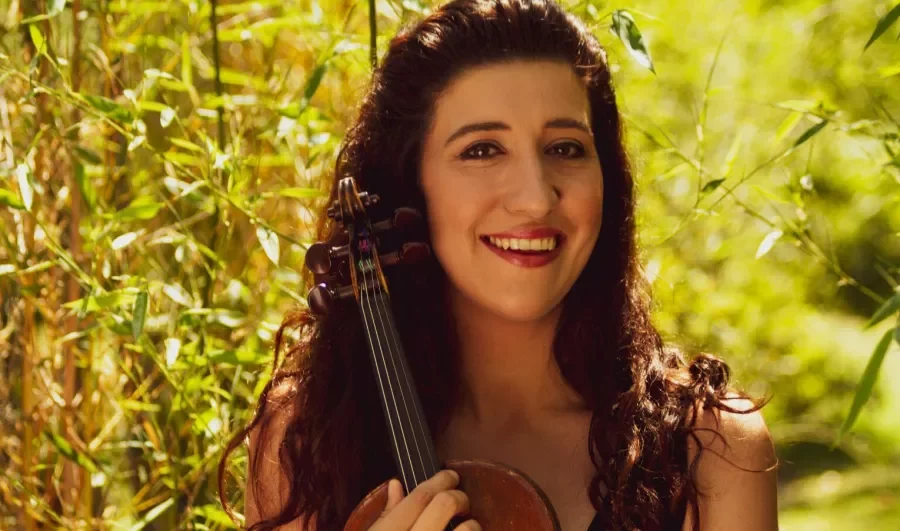
Can you briefly introduce yourself — where you come from and what led you to music?
I have been a violinist for as long as I can remember. The violin was never just one activity among others; it has always been a language, something self-evident, a way of being in the world. I gave my first professional concerts at the age of nine, and performed as a soloist with orchestra from thirteen. Very early on, the stage established itself as a natural space — almost an organic one. Choosing music as a profession was never a question. It wasn’t about deciding whether music would be part of my life, but rather about understanding how I could devote my life to it — with rigor, commitment, and depth.
What kind of training did you pursue? What were your studies like?
My path is quite unusual, as I never followed the traditional conservatory route. I moved between private lessons, violin school, and masterclasses.
At thirteen, I entered the Geneva High School of Music (HEM) for a Bachelor’s degree in the class of Marie-Annick Nicolas, and later continued with a Soloist Master’s under Jean-Pierre Wallez. At the same time, I had the privilege of working regularly in masterclasses with Ivry Gitlis — a profoundly influential artistic encounter, marked by immense freedom.
I deeply loved my years at the HEM. Despite my young age, I felt surrounded and supported with genuine kindness — from the administration, the teachers, and the other students. I was already performing frequently while continuing my schooling in France; it required rigorous organization, but everything unfolded smoothly.
Looking back, I see this path as something tailor-made: both structured and free, demanding yet deeply human.
Where are you in your career today? What does your daily life as an artist look like?
I feel I’ve reached a moment in my life where everything I’ve built since childhood has come into a form of unity.
The stage remains the living center of my journey. Performing as a soloist, carrying a program, stepping into the silence of a hall and sensing that shared tension before the first note — it remains a profound necessity. Concerts shape my year, each one the culmination of a patient, often invisible process of work. It is a relationship with long-term time, with maturation — something that also extends into my recordings with the Calliope label. The studio imposes a different truth than the stage: more stripped down, more definitive. My recordings are traces of these periods of intense research — almost crystallizations.
Very naturally, this artistic path has been accompanied by a need to transmit. Teaching in France and at the Conservatoire Populaire de Genève is not a secondary activity; it is part of my balance. Supporting young musicians in shaping their artistic thinking, their autonomy, and their inner standards feels inseparable from my own work as a performer. Teaching compels clarity, depth, and constant movement. The books I have published with Éditions Delatour France grew out of this same necessity: to put into words what years of study and stage experience have taught me, to structure a reflection on gesture, sound, and presence.
In recent years, another space has opened up: the world of large corporations. There, I speak about leadership, presence, and managing pressure — but fundamentally, I am always speaking about the same things: responsibility, listening, and commitment. I don’t feel that I have several professions; I simply express the same principles in different contexts.
My daily life alternates between rehearsals, writing, teaching preparation, and travel. Over time, I’ve come to understand that artistic quality also depends on a broader balance: caring for the body as a full-fledged instrument, nourishing the mind through culture and encounters, and preserving moments of silence and rest. A career is not a succession of events, but an organic construction that requires as much discipline as it does breathing space.
Looking back, what key elements have helped you in your professional life?
International competitions were turning points. They confronted me with my limits, with pressure, and with constant comparison. I understood quite early that I couldn’t cross certain thresholds through tension or sheer will alone. I had to transform the way I worked: bringing in more calm, reflection, and awareness of movement. And above all, learning a form of kindness toward myself, without ever giving up on high standards.
Of course, the results mattered. But the real shift was internal. It was by finding stability and clarity that I was able to move forward.
And at the center of everything, there has always been joy.
The joy of playing, of entering the sound, of feeling the vibration unfold in a hall. The joy of sharing, of teaching, of seeing a student suddenly grasp something essential. And also a more intimate joy — the one that gives meaning to hours of solitary work.
Over time, I realized that every important decision had to pass through a simple question: will this make me more deeply happy, or bring more beauty into the world? This compass has helped me make choices that were sometimes demanding, but always coherent.
Resilience allows you to endure.
Joy gives you direction.
Is there anything you wish you had known when you finished your studies?
When I left my studies, I was artistically prepared, but much less so for the concrete reality of the profession.
The transition from the structured framework of the Geneva High School of Music to what came after was more abrupt than I had imagined. For years, everything is organized around you — classes, deadlines, projects. Then suddenly, the framework disappears. You have to chart your own path, define your strategy, create your opportunities, manage administration, communication, contacts, negotiations… all while continuing to work on your instrument at the highest level.
I think I would have liked more support during that transition — not artistically, but logistically and structurally. To understand earlier that a career does not rely solely on musical quality, but also on solid organization, long-term vision, and sometimes a real team.
The world of agencies and artistic management can be valuable, of course, but it doesn’t always replace the kind of comprehensive support a young artist needs when starting out. I had to learn by doing, sometimes in a certain solitude.
In hindsight, that period forced me to develop a sense of autonomy and strategic clarity that still serves me today. But if I had one wish for young musicians, it would be that they be better prepared for this entrepreneurial dimension of the profession — without it ever compromising their artistic depth.