


- The school
- Studies and Research
- BACHELOR
- MASTER
- DOCTORATE
- RESEARCH
- TRANSDISCIPLINARITY
- POOLS
- CONTINUING EDUCATION
- Continuing education 2025-2026
- Artificial Intelligence, initiation
- Artificial Intelligence, Advanced
- Artificial intelligence open-source, ComfyUI
- Creative coding
- Engage with drawing
- Frame-by-frame animation
- Immersive Mapping : Unreal Engine & MadMapper
- 3D exhibition modeling in SketchUp
- 3D modeling, Blender
- Point cloud scanning
- Documentary podcast
- Serious games
- For students
- Studying at the HEAD
- Living in Geneva
- Tuition fees and sholarship
- Library
- Regulations and instructions
- Projects
- Events
- Press
- Partnerships and prizes
Immersive Mapping : Unreal Engine & MadMapper
Real-time Audiovisual Creation with Unreal Engine & MadMapper
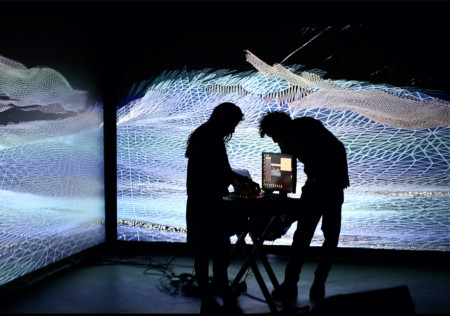
This training offers an in-depth introduction to designing immersive audiovisual spaces using Unreal Engine and MadMapper. Participants learn to create real-time visual content, broadcast and project it onto multiple surfaces, and develop a complete video mapping setup, from digital scene to physical installation. The course combines technical input, practical workshops and project work to cover the entire workflow: design, prototyping, calibration and implementation of an immersive installation.
Throughout the sessions, you will explore:
- the fundamentals of Unreal Engine for real-time creation (interface, scenes, cameras, lighting, materials, animations)
- preparing and optimising dynamic visuals for projection
- using MadMapper for multi-surface video mapping and projector management
- principles of audiovisual integration, synchronisation and real-time (live) control
- the basics of spatialisation and interactive control of an installation
Target Skills
By the end of the training, participants will be able to:
- design an immersive installation, from initial concept to working prototype
- create a real-time scene in Unreal Engine (materials, lighting, cameras, animations)
- generate and route a real-time video stream from Unreal Engine to MadMapper
- execute multi-surface video mapping and calibrate one or more projectors
- synchronise and control scene parameters in real time (live controls)
- optimise media for projection (formats, frame rates, performance)
- diagnose and resolve common issues in immersive installations (geometry, keystone, latency, tearing, alignment, stability)
Expected Outcomes
By the end of the training, participants will have:
- created a working immersive prototype as a group
- gained a clear methodology for developing their own audiovisual installations
- developed a thorough understanding of the technical and artistic challenges involved in real-time immersive installations
Target Audience
Artists, designers, technicians, scenographers, audiovisual professionals and anyone wishing to integrate immersive audiovisual experiences and real-time technologies into their practice.
Prerequisites
No prior knowledge of Unreal Engine or MadMapper is required. General familiarity with computers and digital creation tools is recommended. A laptop is necessary.
Training Duration: 5 consecutive days
Dates: The dates of the next session will be communicated soon
Schedule: 9am to 12.30pm and 1.30pm to 5pm
Format: lectures / practical workshops / group project
Language: French (English possible)
Location: HEAD Campus, Building E, av. de châtelaine 5, Genève
Fees: CHF 1,500 / HEAD – Genève Alumni CHF 1,200
View the detailed programme
Day 1 — Introduction to immersive space & Unreal Engine basics
Overview of immersive practices
History and typologies: installation, scenography, exhibition, performance
Immersion logic: perception, scale, light, sound, spatiality
Presentation of the joint project and general workflow: content → real-time engine → projection → calibration
Introduction to Unreal Engine
Interface and navigation
Real-time logic
Project organization
First immersive scene
Creating a simple space (geometry, light, camera)
Introduction to materials
Basic animation (camera, objects)
Goal for the day: understand the logic of the real-time engine and produce a first projectable scene.
Day 2 — Unreal Engine for immersive projection
Lighting, atmosphere, and composition
Static vs. dynamic lighting
Post-processing
Depth, fog, contrast
Composition for projection (considering surface, angle, distance)
Dynamic content
Animated materials
Exposed parameters
Introduction to real-time control (Midi and OSC)
Optimization for projection (resolution, performance, frame rate)
Day 3 — MadMapper & video mapping
Introduction to MadMapper
Interface and surface logic
Simple mapping
Projector calibration
Masks, distortions, keystone
Demonstration in the Grey Box
Mapping continued
Multi-surfaces
Multi-projector management
Real-time video streaming (NDI/Spout depending on platform)
Day 4 — Interaction & spatialization
Unreal ↔ MadMapper dialogue
Signal routing
Live parameter control
Introduction to simple interactive logic
Project workshop (start)
Forming groups
Defining an artistic intention
Designing a mini immersive device
Technical tests
Day 5 — Production & presentation
Finalizing projects
Visual adjustments
Technical optimization
Rehearsal/calibration
Teacher
Laurent Novac
Laurent Novac is an artist and engineer based in Geneva, and a member of Z1 Studio.
Z1 Studio is a Geneva-based studio active in the field of contemporary artistic creation, at the crossroads of visual arts, digital art, performance, and immersive devices.
Z1 Studio is a Geneva-based studio active in the field of contemporary artistic creation, at the crossroads of visual arts, digital art, performance, and immersive devices.
He collaborated for more than ten years on the development of MadMapper, contributing to the evolution of one of the most widely used video mapping software programs in the fields of art, scenography, and events. This experience has given him in-depth expertise in immersive devices, multi-projector mapping, and real-time control systems.
He teaches at HEAD – Geneva, notably in Media Design, where he guides students in their exploration of immersive environments and real-time tools.
His teaching approach aims to convey both a conceptual and operational understanding of immersive environments, enabling participants to develop sensitive, critical, and technically mastered devices.
Enquiries and registration:
Contact : fc.head@hesge.ch
Registration form
Terms and conditions
View all our continuing education modules.
© 2018 HEAD – Genève, Haute école d'art et de design