


- The school
- Studies and Research
- BACHELOR
- MASTER
- DOCTORATE
- RESEARCH
- TRANSDISCIPLINARITY
- POOLS
- CONTINUING EDUCATION
- Continuing education 2025-2026
- Artificial Intelligence, initiation
- Artificial Intelligence, Advanced
- Artificial intelligence open-source, ComfyUI
- Creative coding
- Engage with drawing
- Frame-by-frame animation
- Immersive Mapping : Unreal Engine & MadMapper
- 3D exhibition modeling in SketchUp
- 3D modeling, Blender
- Point cloud scanning
- Documentary podcast
- Serious games
- For students
- Studying at the HEAD
- Living in Geneva
- Tuition fees and sholarship
- Library
- Regulations and instructions
- Projects
- Events
- Press
- Partnerships and prizes
HEAD at the Milano Design Week 2026
No One Sees Them Like We Do
Exhibition from April 20 to 26, 2026, 11 a.m. to 7 p.m.
Opening on April 21, 2026, at 5 p.m.
Alcova Baggio
Military Hospital Complex
Via Giovanni Labus 15, 20147 Milano
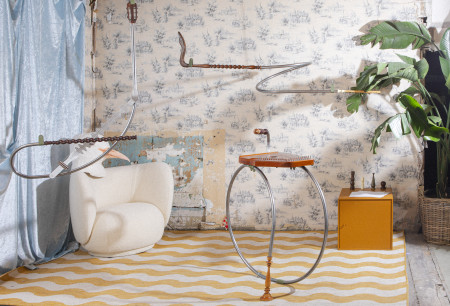
As part of Milano Design Week, HEAD – Genève presents No One Sees Them Like We Do: Notes on Animal Interiors at Alcova an exhibition imagined and developed by the students of MAIA – Master in Interior Architecture, on view until 26 April 2026. Through six spatial narratives, the project offers a sensitive perspective on the role of so-called companion animals in our living spaces, and on the evolving forms of coexistence between humans, animals, and their environments.
Conceived as a constellation of objects, devices, and fragments of infrastructure, the exhibition approaches animals not as symbols, but as beings with whom we fully share our everyday spaces. It pays close attention to the quiet rituals of care, the subtle dynamics of cohabitation, and the often-overlooked domestic adjustments that reveal how we relate to the living world.
Rats, dogs, pigeons, frogs, and other species inspire six distinct proposals developed by the students. Each draws on a fable to open up new ways of imagining the relationships between humans and non-humans.
This project is part of an ongoing line of research developed within the MAIA – Master of Interior Architecture, focusing on the material and spatial forms of interspecies cohabitation. It extends the work initiated during the symposium Animals Inside: A History of Objects and Furniture for Pets in Domestic Interiors, held at HEAD – Genève in November 2025, which explored the history of objects, furniture, and architecture related to companion animals, from Antiquity to the digital age. At HEAD – Genève, this research informs a teaching approach rooted in experimentation, where design itself becomes a critical tool for investigating the relationships between space, living beings, and use.
Presented at Alcova, a leading platform on the international design scene, the exhibition positions HEAD – Genève within contemporary discussions on interior architecture, ecology, and curatorial practices. It reflects the MAIA program’s pedagogical approach, where research, experimentation, and full-scale (1:1) production are conceived as an integrated process.
Developed by the students of the Master in Interior Architecture, the project is led by Youri Kravtchenko, architect, professor at HEAD – Genève, and founder of Ykra, in collaboration with David Valadomiu Ceballos and Marie Schild, teaching assistants in the MAIA program.
Six animals, six spatial narratives:
There Are Seven Doves Dancing in My Home by Hugo Maia Schmitt and Letizia Milone ; Dogs Are Not Only Creatures by Stéphanie Hemidi, Kim Sherin Schönauer and Jérémy Troilo ; Frogs in Search of Wetlands by Martino De Grandis and Ailyn Pieyre ; MEUW (Socius Novus) by Jaemo Lee and Lisa Schober, video by Christof Nussli ; Feast for Rats by Matilde Arletti, in collaboration with the Collectif la Dalle (Julie Chavaz & Angélique Kuenzle), with drawings by Annie Bornet ; Some Animals Hide to Die by Diana Escalante and Karol Szmigielski
Download the press kit
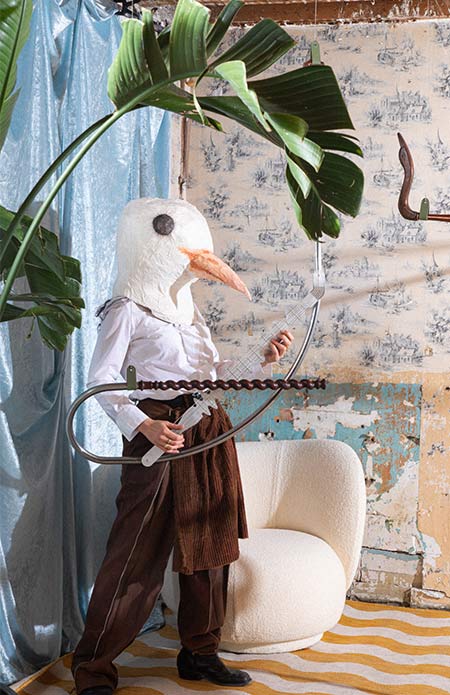
No One Sees Them Like We Do. Notes on Animal Interiors
© HEAD – Genève, Raphaelle Mueller et Sylvain Leurent
© HEAD – Genève, Raphaelle Mueller et Sylvain Leurent
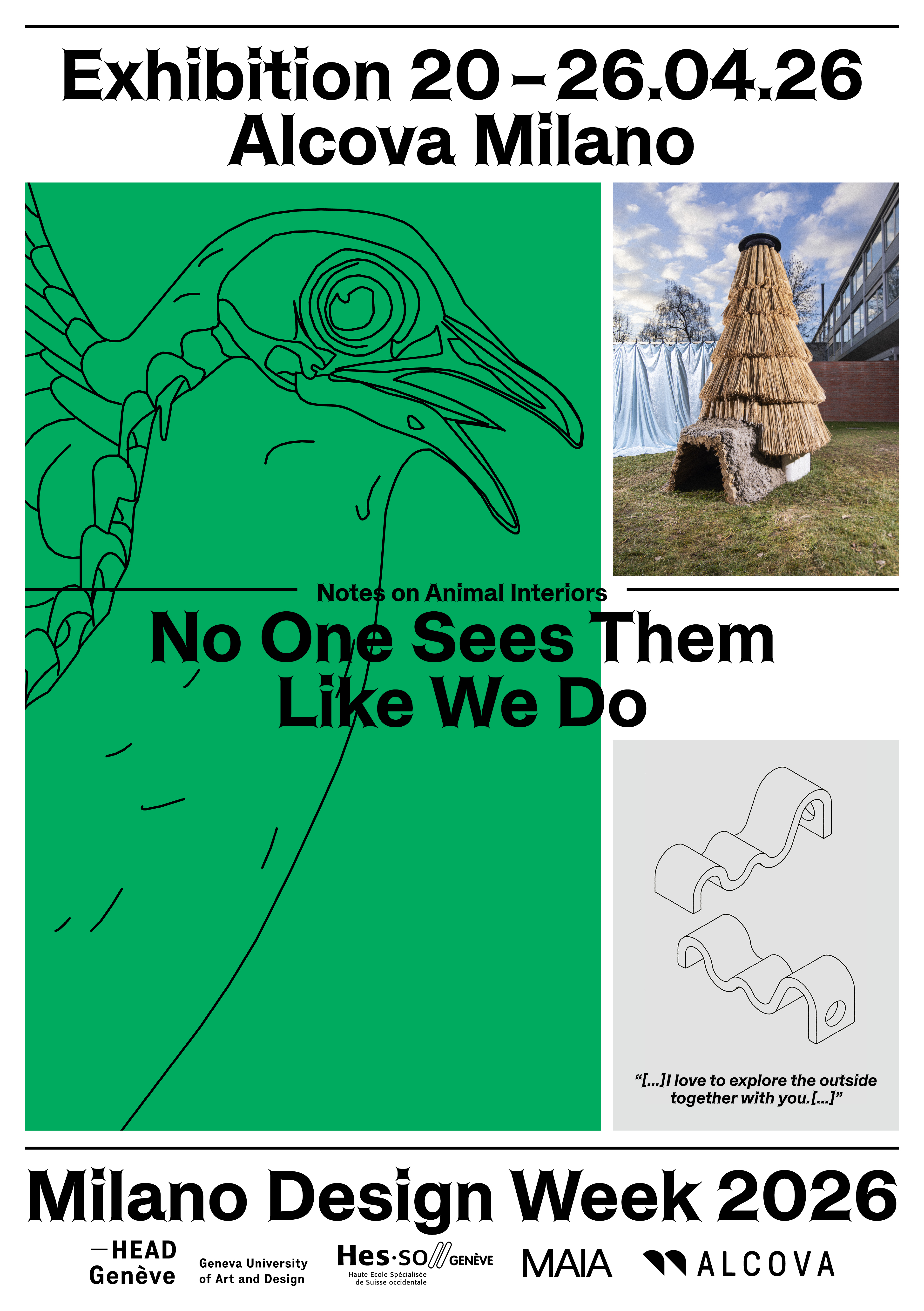
No One Sees Them Like We Do. Notes on Animal Interiors
© Graphique Design by Onlab Studio
© Graphique Design by Onlab Studio

© 2018 HEAD – Genève, Haute école d'art et de design