


- The school
- Studies and Research
- BACHELOR
- MASTER
- DOCTORATE
- RESEARCH
- TRANSDISCIPLINARITY
- POOLS
- CONTINUING EDUCATION
- Continuing education 2025-2026
- Artificial Intelligence, initiation
- Artificial Intelligence, Advanced
- Artificial intelligence open-source, ComfyUI
- Creative coding
- Engage with drawing
- Frame-by-frame animation
- Immersive Mapping : Unreal Engine & MadMapper
- 3D exhibition modeling in SketchUp
- 3D modeling, Blender
- Point cloud scanning
- Documentary podcast
- Serious games
- For students
- Studying at the HEAD
- Living in Geneva
- Tuition fees and sholarship
- Library
- Regulations and instructions
- Projects
- Events
- Press
- Partnerships and prizes
ADDRESSING INTERIOR VIOLENCES
From 23rd to 24th february 2026
HEAD – Genève
The Cube
Avenue de Châtelaine 7,
1203 Geneva
To address spatial violence from within a school of interior architecture is to acknowledge interior spaces as more than politically neutral backgrounds. They should not be understood as mere décors for the everyday lives of predefined identities, but rather as materially situated conditions that actively participate in shaping social and political interactions. Addressing Interior Violences follows Michel Foucault’s reflections in Discipline and Punish (1975) by considering interior architecture as a set of biopolitical techniques of control over bodies and subjectivities. These techniques uphold the construction of the “normal” subject: that is, the able-bodied, white, young, human, bourgeois, heterosexual, male subject. At the same time, the symposium questions the mirror image of this figure: the spatial production of the monstrous, the excluded, and the dehumanized. Building on the writings of Lennard J. Davis (2002), the symposium seeks to interrogate the role of interior spaces in perpetuating power structures organized around the Western and modern notion of normalcy.
The symposium is structured into three panels, each corresponding to a thematic half-day. The first panel, Learning Histories of Violence, examines the historical construction of bodily and spatial norms in interior architecture and the ways in which these norms have produced and legitimized exclusion. The second panel, Questioning Weaponized Interiors, focuses on contemporary interior conditions as technologies of regulation and boundary-making, exploring how they sustain power relations while also opening possibilities for resistance and negotiation. The third panel, Visibilizing Dissident Practices and Projects Involving Interiors, highlights practices and projects that translate critical thought into spatial action and research methodology, proposing alternative tools aimed at countering interior violences and fostering emancipatory, caring environments.
See full program here.
A conference organized by HEAD – Genève, Interior Architecture Department
Scientific Comitee: Valentina De Luigi, Javier Fernández Contreras, Paule Perron
Logistic support: Lucie Landenbergue, Alexandra Miskufova
Technical support: Matthieu Prêtre, Frédérique Trane
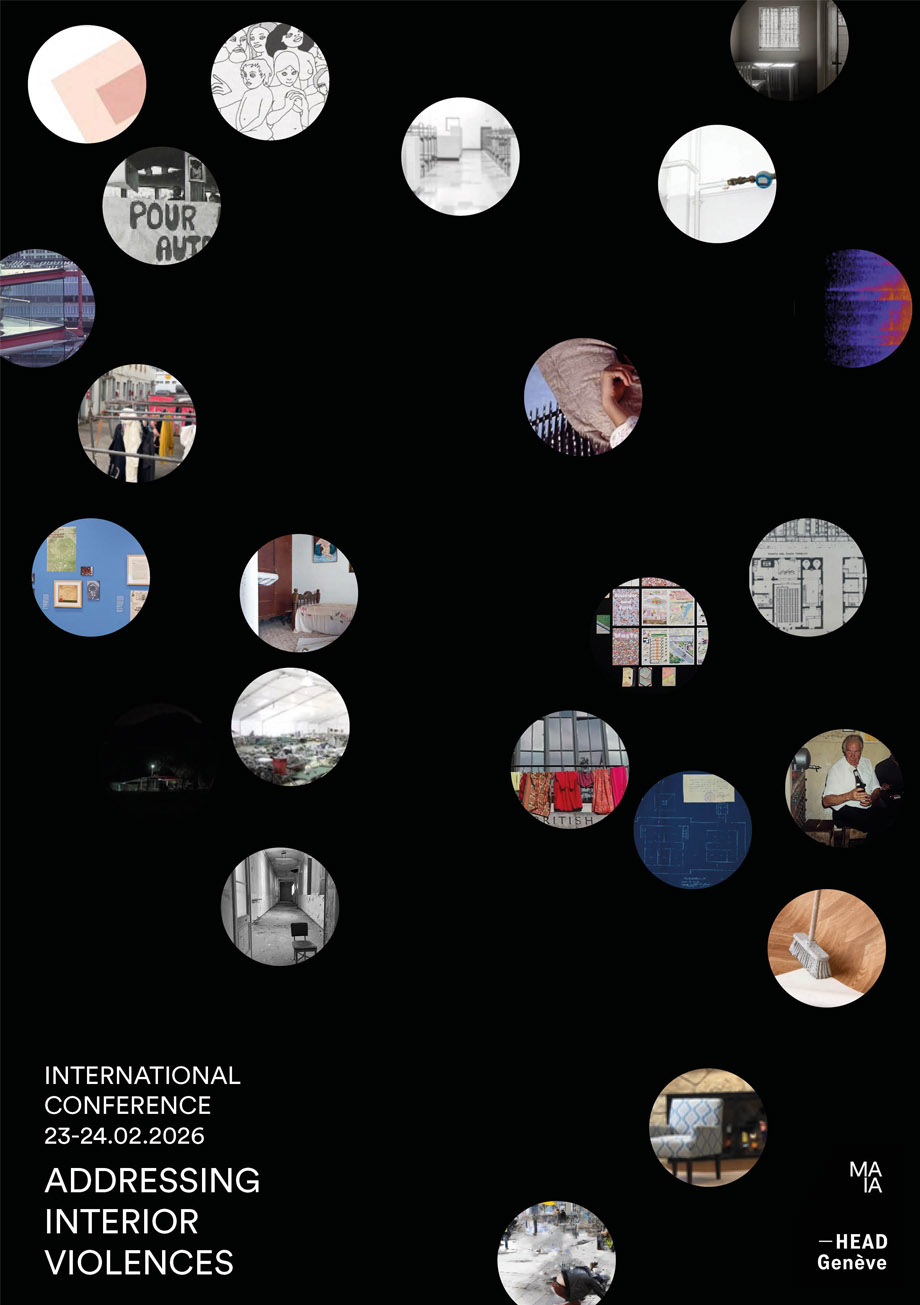
ADDRESSING INTERIOR VIOLENCES
© HEAD – Genève
© HEAD – Genève
© 2018 HEAD – Genève, Haute école d'art et de design