


- The school
- Studies and Research
- BACHELOR
- MASTER
- DOCTORATE
- RESEARCH
- TRANSDISCIPLINARITY
- POOLS
- CONTINUING EDUCATION
- Continuing education 2025-2026
- Artificial Intelligence, initiation
- Artificial Intelligence, Advanced
- Artificial intelligence open-source, ComfyUI
- Creative coding
- Engage with drawing
- Frame-by-frame animation
- Immersive Mapping : Unreal Engine & MadMapper
- 3D exhibition modeling in SketchUp
- 3D modeling, Blender
- Point cloud scanning
- Documentary podcast
- Serious games
- For students
- Studying at the HEAD
- Living in Geneva
- Tuition fees and sholarship
- Library
- Regulations and instructions
- Projects
- Events
- Press
- Partnerships and prizes
Performing Archeology
Colloque
Monday 8th and Tuesday 9th December 2025
Campus HEAD,
Design Room, bâtiment H
Av de Châtelaine 5
1203 Genève
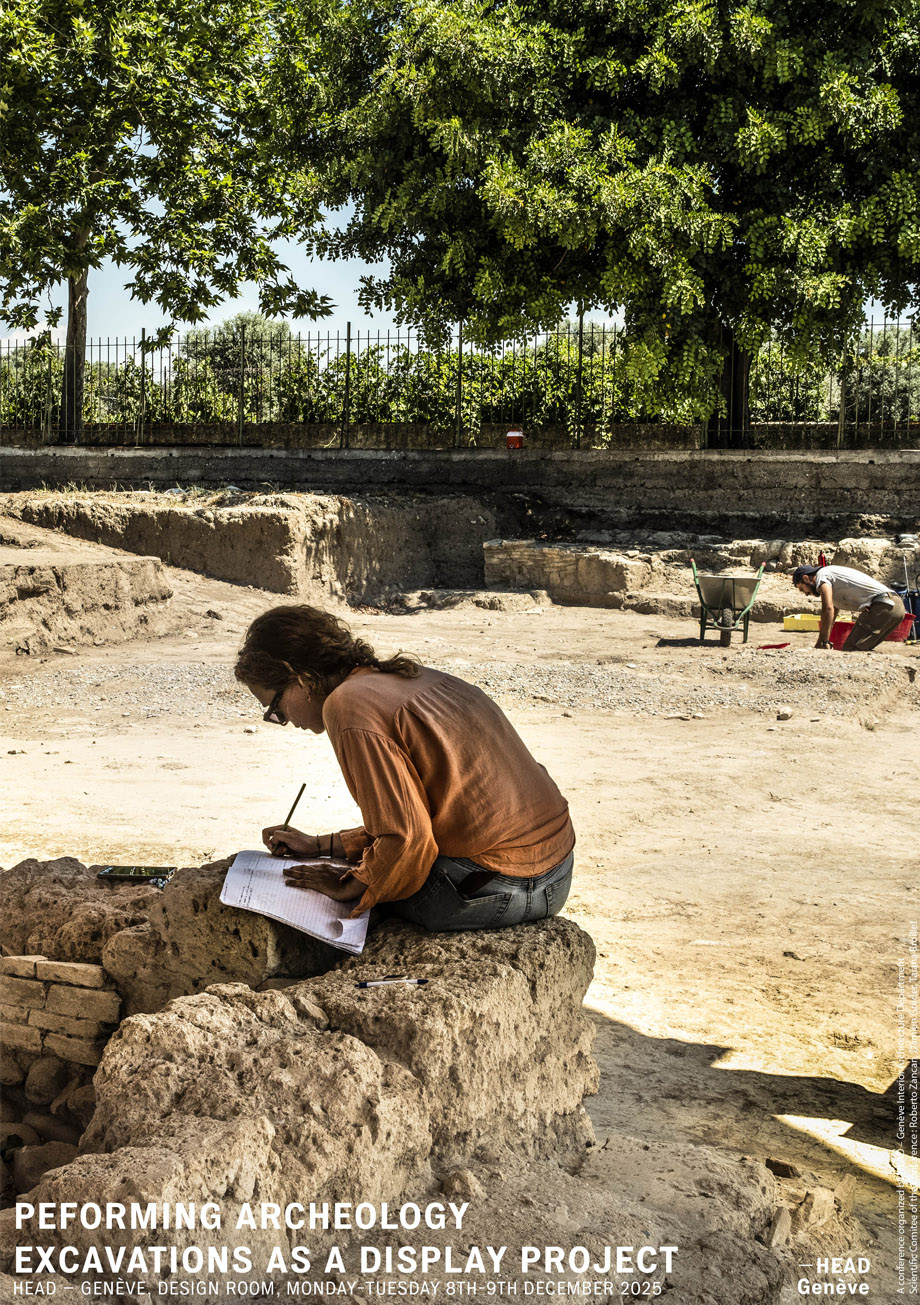
Historically regarded as a discipline of collection, documentation, and interpretation, archaeology has increasingly embraced the embodied, spatial, and dramaturgical dimensions of its practice. Since the 1990s, performance archaeology has challenged traditional paradigms by considering the excavation site not merely as a source of data, but as a temporal and material stage where knowledge, presence, and representation intersect.
In parallel, interior architecture-understood as the practice of reactivating existing spaces without new construction—has emerged as a key framework for transforming archaeological sites into interpretive environments. Stratigraphy, artifact discovery, site protocols, and tools become scenographic elements within open-air museums that communicate research in real time.
The symposium Performing Archaeology: Excavations as a Display Project explores the performative turn in contemporary archaeological practice, foregrounding the convergence of excavation, scenography, and spatial design. This seminar traces a path from the material traces of antiquity to experimental media, questioning how archaeology can be a dynamic practice of storytelling and sensory engagement.
Bringing together researchers, designers, and practitioners, the symposium critically examines how excavation itself becomes a performative act. It interrogates the implications of this shift for memory, identity, and the materiality of heritage in the digital age, with a particular emphasis on the contributions of interior architecture to the theorization and mediation of archaeological space.
Over different sessions, the seminar will gather voices from art, design, history, and archaeology to reflect critically on how performative methods transform our understanding of heritage and space.
You can access the detailed programme via the pdf here!
Performing Archeology
© HEAD – Genève
© HEAD – Genève
© 2018 HEAD – Genève, Haute école d'art et de design