Strontium-90 (⁹⁰Sr) is an artificial radionuclide released during nuclear facility accidents (Chernobyl, Fukushima Daiichi) and military nuclear tests (South Pacific, Semipalatinsk). It is also present, although to a lesser extent, in effluents from nuclear power plants, and in higher proportions in liquid waste from reprocessing facilities (La Hague, Sellafield). Because of its chemical and biochemical similarity to calcium, more than 99% of the strontium present in living organisms accumulates in bones and teeth. Prolonged internal exposure to ⁹⁰Sr and to its decay product, yttrium-90 (⁹⁰Y), increases the risk of leukemia and bone cancers.
Laboratory experiments using cultures enriched with stable strontium isotopes had already shown that certain microorganisms can incorporate this element efficiently. Among them, green microalgae of the class Chlorodendrophyceae, capable of forming intracellular inclusions of amorphous calcium carbonate enriched in strontium, appear to be promising candidates for bioremediation.
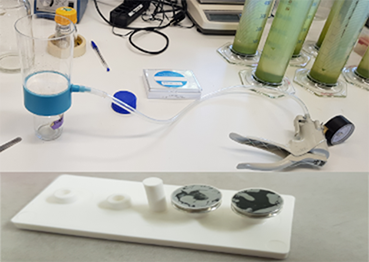
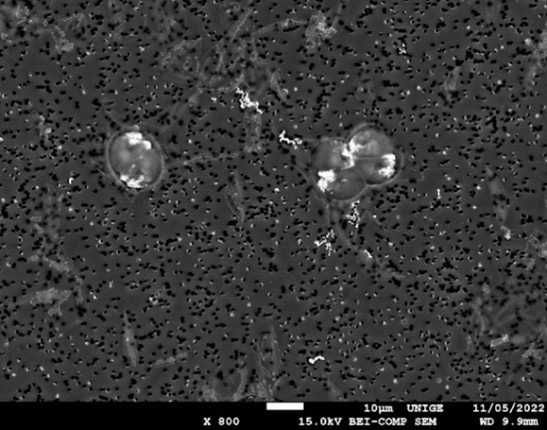
The project, completed in 2023, aimed to determine whether these algae are also capable of accumulating ⁹⁰Sr under conditions close to the natural environment. To this end, the uptake capacity of Tetraselmis chui for ⁹⁰Sr was assessed by monitoring the evolution of radioactivity in the culture medium using liquid scintillation counting (LSC). The results show that T. chui effectively sequesters ⁹⁰Sr: the cells reduced the initial radioactivity of the culture medium by up to 50%. This behavior confirms their ability to actively capture this radionuclide, even in the presence of stable isotopes at natural concentrations.
Thus, this study provides concrete evidence for the potential of T. chui as a bioremediation agent for mitigating ⁹⁰Sr pollution.
The project was carried out in collaboration with the Department of Earth Sciences at the University of Geneva and funded by the Gebert Rüf Stiftung (Basel, Switzerland) under the project Microbials GRS-071/17. The full results were published in Environmental Science: Processes & Impacts (2024).
Project partner(s)
Project leader - team
Stavroula Pallada
(HEPIA),
Gilles Triscone (HEPIA)
,
Anastasios Kanellakopoulos
(HEPIA),
Axel Baxarias Fonaine (HEPIA)