Biomarkers used in medicine, are a measurable indicator of some biological states or conditions and are a part of a relatively new clinical toolset categorised by their clinical applications. Their clinical role is in narrowing or guiding treatment decisions and follow a sub-categorization of being either predictive, prognostic or diagnostic. Biomarkers are often measured and evaluated using blood, urine or soft tissue to examine normal biological processes, pathogenic processes or pharmacologic responses to a therapeutic intervention.
Tuberculosis (TB) is a widespread condition that is even coming back to our regions. The current test techniques are based on an invasive procedure, a sputum test. A strategy has been developed for a triage test from blood, which abides the World Health Organisation’s target product profile (TPP). The four biomarkers that have been identified allowing for a TB triage test are IL-6, IL-8, IL-18 and VEGF. However, heavy and bulky equipment is needed to measure these biomarkers in their respective concentrations.
The ultimate goal of current endeavours to improve TB triage tests is to use a technique that can be performed at point-of-care in any endemic region, or any region for that matter. For achieving this objective, we have to take tackle the following unmet diagnostic needs:
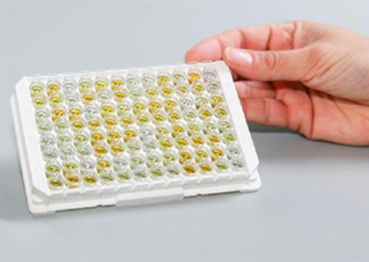
In this preliminary research project, we aim to establish a proof-of-concept chemistry capable of meeting the above cited diagnostic needs, which can be factored in a standard 96-well plate. The ensuing chemical reaction and the test result should be spontaneous (at least over a wide acceptable range of temperatures) and cheap, at least at scale.
At the end of the current preliminary study we aim to achieve a successful proof-of-concept. This technology should show its capability of generating a signal at 0.1 pG/mL for IL-8, one of the markers for a TB triage test. For this we will spike human serum from 0.1pG/mL to 1000pG/mL and construct a calibration curve as well as report the obtained coefficients of variability.
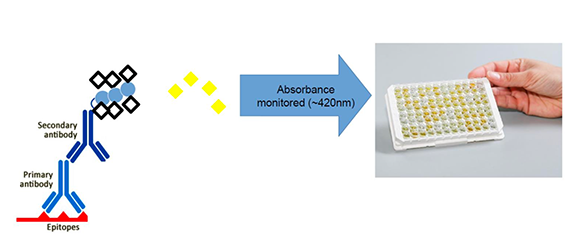
Graphical representation of the proposed chemistry.
This project received financial support from the Office for the Promotion of Industries and Technologies (OPI).
Project partner(s)
Project leader - team
Stavroula Pallada
(HEPIA),
Martina Zsély Schaffter
(HEPIA),
Quentin Rogliardo (HEPIA)