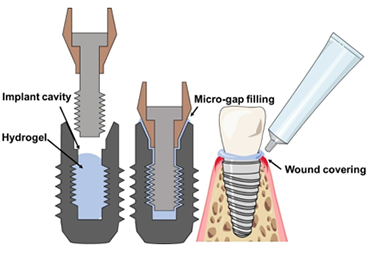
Supported by the Swiss National Science Foundation (SNSF), the project aims to develop an innovative hydrogel composed of peptides and silver and/or copper nanoclusters to prevent peri-implantitis in the context of dental implants. Using glutathione (a natural peptide) as a ligand, the nanoclusters act as reinforcing agents within the glutathione network, emitting fluorescent light under UV, allowing for real-time monitoring. The gel is water-based and free from hazardous chemicals, making it suitable for medical use. Its structure also allows for the incorporation of active components to improve healing and post-operative pain.
The project aims to design an antimicrobial gel composed of peptides and nanoclusters. Different gels will be created to optimize rheological and antibacterial properties. The bactericidal component will be provided by the release of metallic ions, generating a broad-spectrum antimicrobial environment, while glutathione will contribute anti-inflammatory properties to the gel. The antimicrobial activity and cytotoxicity of the gel will be evaluated in vitro. The stability, storage, characteristics, and biodegradability of these systems will be studied, and the gels will be optimized for dental application, paving the way for future research in the field.
The project addresses a need in post-surgical dental care. By focusing on the prevention of peri-implantitis, the gel offers an innovative solution for post-operative use. The antimicrobial properties of the gel, combined with the anti-inflammatory capacity of glutathione, open the door to promising biomedical applications in the dental field.
Thumbnail image: Micro-gap filling after hydrogel injection and application on the tissue surrounding the wound after surgery.
Project partner(s)
Project leader - team
Irena Milosevic
(HEPIA),
Vincent Pautu
(HEPIA),
Fabrice Marger
(HEPIA)