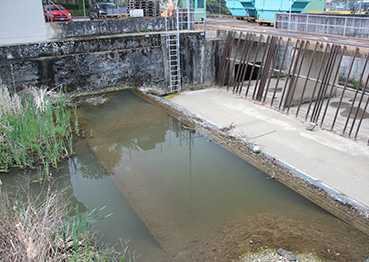
The Drize River restoration project within the Praille Acacias Vernets (PAV) redevelopment area is one of the flagship river restoration projects in the Geneva region. The diversion intake, located at Route de Saint-Julien, is the critical hydraulic node that ensures both the water supply to the restored river reach and flood protection for the surrounding urban district.
The project presents significant hydraulic challenges related to the operation of the diversion structure, highly turbulent flow conditions, and the interaction between hydraulic processes and the proposed river restoration works. Many of the expected flow features — including turbulence, flow separation, recirculation zones, and rapid water-level fluctuations — cannot be accurately reproduced using numerical models alone. For this reason, a physical hydraulic model is considered an essential tool for faithfully reproducing these complex processes and validating the proposed engineering solutions.
By combining innovative approaches, such as the 3D printing of a modular system of interchangeable components, the LH²A laboratory aims to establish itself as a leading centre of expertise in physical hydraulic and sediment transport modelling. Beyond its scientific value, the project will provide independent technical support to the engineering consortium, thereby contributing to informed decision-making throughout the design process.
This work builds on the successful experience gained during the Drize–Arve Fish Passage physical modelling project and further strengthens the laboratory's expertise in hydraulic modelling for complex river restoration and flood risk management projects.
Project partner(s)
Project leader - team
Davide Ceresetti
(HEPIA),
Nicolas Andreini
(HEPIA),
Nicolas Duparc
(HEPIA),
Anthony Garcia
(HEPIA),
Alexandre Schaller
(HEPIA)