Present everywhere on the globe at varying concentrations, uranium-composed primarily of isotope 238-decays through a radioactive chain of 13 radioelements known as «daughters of U-238» until it eventually becomes stable lead-206. One of these daughters is radon-222, a noble gas from the periodic table of elements. This daughter, chemically neutral, is therefore able to diffuse and, if the rock allows (for example a porous rock), escape into the open air.
Thus, this radioactive gas - odorless, colorless, and tasteless - is found across the entire Earth. Radon itself is not harmful because it is an inert noble gas that does not bind in the lungs. However, once it decays, it becomes polonium-218, then quickly lead-214, and so on, transmuting into other radioactive chemical elements. These latter are not chemically neutral; they attach via electronic bonds to aerosols present in the air. It is these that are harmful to health, as once inhaled they remain within the respiratory tract walls. There, they decay, causing significant damage to healthy cells and DNA, which can lead to lung cancer.
BAQ currently has a detector with excellent metrological characteristics, called RADOM, developed during their stay at CERN. However, it is a high-end device, with a consequently high sale price, intended for experienced users and not the general public. Inside it are filters that must be replaced, components that require cleaning, and a small pump to move the air that needs maintenance.
The aim of this research work is to design a new sensor for measuring the concentration of radon-222 daughters that is precise, fast, maintenance-free, and affordable, aimed at the general public. More specifically, we seek to develop an innovative air intake device that will allow us to eliminate the mechanical pump and replace it with an electrostatic pump. This new pump technology generates an electric field and can direct ionized particles present in the air in a desired direction. The shape of the field depends on the pump’s geometry. Modeling calculations and numerical simulations were carried out using COMSOL Multiphysics to simulate the interaction between an electric field and charged particles, in order to optimize and validate the pump’s design.
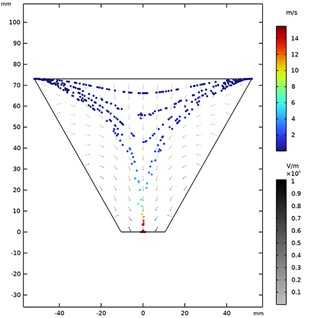
Figure above: Trajectory and velocity of particles (m/s) of 1 nm (t = 58 ms). The arrows represent the shape and magnitude of the field (V/m). The particles reach a maximum velocity of 15.5 m/s.
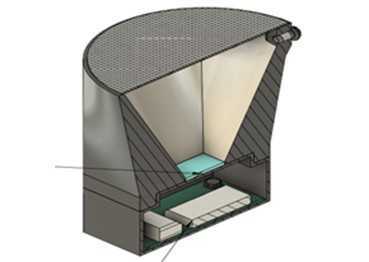
Picture: Illustration of what the electrostatic pump could look like. At the top, the grid allowing particles to enter the trap. At the bottom, the alpha detector. Below that, the connections to the control electronics.
This project received financial support from the Office for the Promotion of Industries and Technologies (OPI).
Project partner(s)
Project leader - team
Stavroula Pallada
(HEPIA),
Gilles Triscone (HEPIA)
,
Anastasios Kanellakopoulos
(HEPIA),
Hugo Corcelle
(HEPIA),
Quentin Rogliardo (HEPIA)