![[missing img]](/head/issue/sites/head_issue/files/image/we%20refuse_d%20M%20HKA.png "/head/issue/sites/head_issue/files/image/we%20refuse_d%20M%20HKA.png")
Poster for the exhibition "we refuse_d" at M KHA, Antwerp (13.03 – 07.06.2026)
Faye Corthésy: we refuse_d is an exhibition that was made in reaction to the cancellation of many Arab artists and intellectuals in Western museums and cultural institutions following the war on Palestine.[note]An overview of the exhibition held at Mathaf, Doha, is published on ISSUE here.[/note] Many of them also withdrew their participation from residencies and prizes in reaction. The idea of co-curating this exhibition apparently came quite spontaneously. Could you tell us how you came to work together on this project, how it all started?
Vasıf Kortun: First, I’d like to say that when people invest many years in preparing exhibitions, they lose sight of the present. They risk forfeiting relevance and urgency, which may also be a convenient way to avoid a public discussion. There’s a strong possibility that the subject in question is already desperately outdated. Museums are often deliberately structured to conceive projects for the far future, which can keep them out of touch with daily realities and urgencies.
We certainly felt the urgency of the moment as we were building up the exhibition: there’s a genocide going on, there’s a war on a country of unforeseen scale on civilian space. There was always this tension behind us. It affected us, the exhibition, and more particularly the artists participating in it. One would hope that things would resolve themselves in an equitable and just way, but it’s hard to expect this from the world or from politics today.
Concretely, what happened was that Nadia was in Doha for research at Mathaf and she started a conversation with Zeina Arida, the director of the Museum. The conversation pivoted around the idea of refusal. That’s when the plan for the exhibition started. Zeina suggested that we work together, which was a fantastic idea.
F. C.: Did you know each other before working on the exhibition?
V. K.: We knew each other only through communicating online: we had started talking about the Mathaf Encyclopedia for which I’m working as an editor, and about the online publication Manazir that Nadia co-founded.
The original idea for the exhibition was predicated on the notion of refusal, and on European modes of refusal such as the Salon des Refusés in 19th century France. This was the starting point and then we built it into a concrete, urgent, and exciting project.
Nadia Radwan: We had been witnessing this wave of cancellation of artists not receiving their residencies, or prizes, of scholars losing their jobs, all over Europe and the United States. Amongst these, one important event was cancelled: The retrospective of Palestinian artist Samia Halaby,
![[missing img]](/head/issue/sites/head_issue/files/image/2025-mathaf-we-refuse-d-1211_0.jpg "/head/issue/sites/head_issue/files/image/2025-mathaf-we-refuse-d-1211_0.jpg") ">
">
Installation view of Samia Halaby's works in the exhibition "we_refused" at Mathaf. Photograph: Ali Al-Anssari, courtesy of Qatar Museums ©2025
![[missing img]](/head/issue/sites/head_issue/files/image/2025-mathaf-we-refuse-d-1231_0.jpg "/head/issue/sites/head_issue/files/image/2025-mathaf-we-refuse-d-1231_0.jpg") ">
">
Installation view of Samia Halaby's works in the exhibition "we_refused" at Mathaf. Photograph: Ali Al-Anssari, courtesy of Qatar Museums ©2025
F. C.: Was Samia Halaby the first artist you invited? How did you select the fifteen artists who take part in the exhibition? In the introductory text to the exhibition, you mention an “ongoing dialogue” with the artists: how did this dialogue take place? Was there also a conversation between the artists?
V. K.: The first artist included in the exhibition was Samia. The context was traumatic. For example, our colleague Tirdad Zolghadr, who is now curator at Mathaf, lost his teaching position at the University of Arts Berlin. His wife, Oraib Toukan, is one of the artists in the exhibition. Two extremely competent colleagues with
The trajectory we conceived for the exhibition started with Samia and ended with Jumana: This is not relevant to the
We did not have a collective discussion with the artists, but most of them are already in conversation because they know each other. Their works have been shown together in exhibitions; they are colleagues. However, we did speak to each artist individually at length and
Because of the depth of the works, each artist ha
N. R.: It’s important to underline that most of the works were commissions. We were in conversation with the artists about their works, the notion of refusal
![[missing img]](/head/issue/sites/head_issue/files/image/2025-mathaf-we-refuse-d-1255_1.jpg "/head/issue/sites/head_issue/files/image/2025-mathaf-we-refuse-d-1255_1.jpg") ">
">
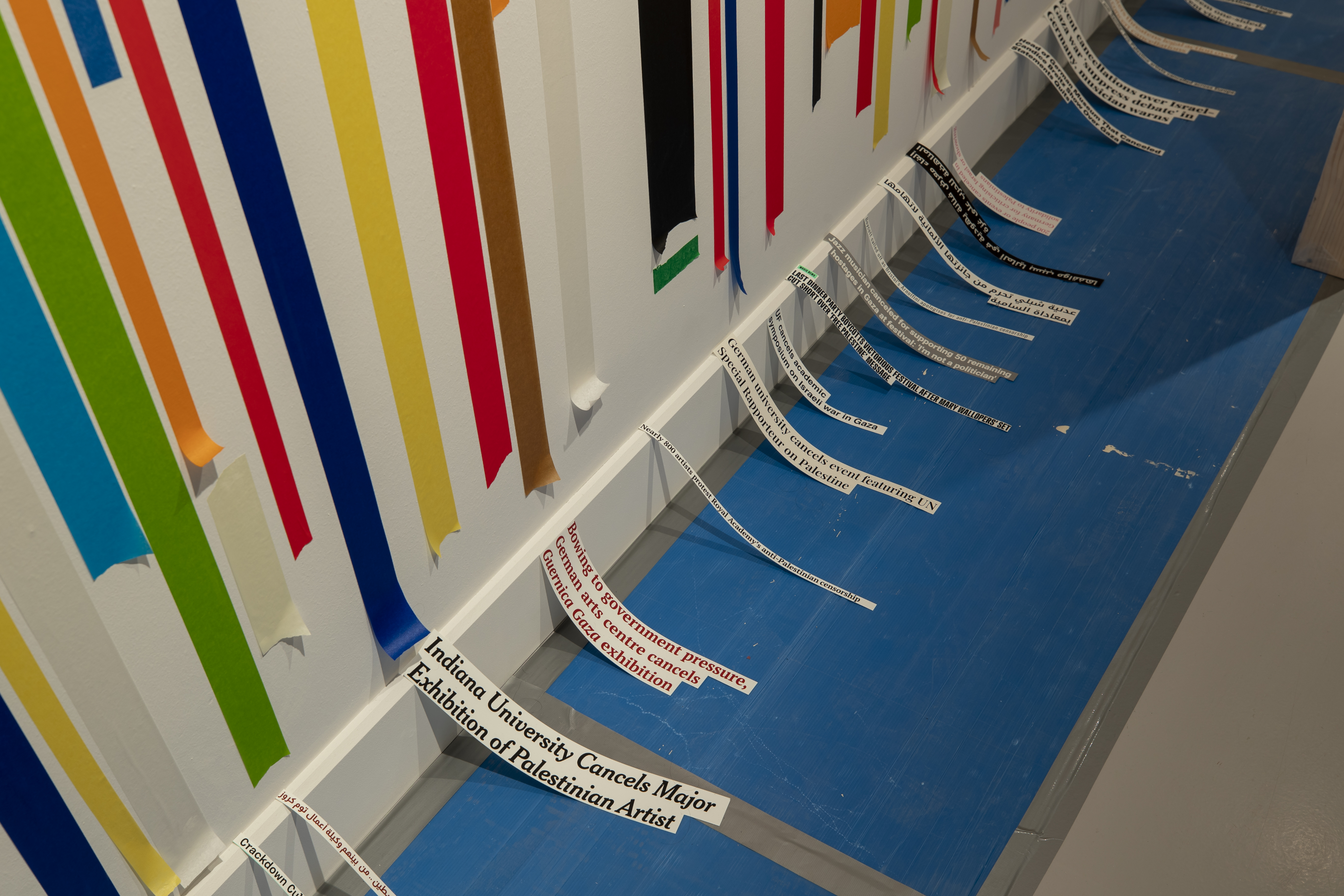
Installation view of Walid Raad and Pierre Huyghebaert's work in the exhibition "we_refused" at Mathaf. Photograph: Ali Al-Anssari, courtesy of Qatar Museums ©2025
![[missing img]](/head/issue/sites/head_issue/files/image/2025-mathaf-we-refuse-d-1253_0.jpg "/head/issue/sites/head_issue/files/image/2025-mathaf-we-refuse-d-1253_0.jpg") ">
">
Installation view of Walid Raad and Pierre Huyghebaert's work in the exhibition "we_refused" at Mathaf. Photograph: Ali Al-Anssari, courtesy of Qatar Museums ©2025
F. C: You spoke about the notion of refusal that is central to the exhibition, starting from its title. “we refuse_d” suggests a shift from passive to active, from being refused to refusing. You say that refusal is not only an act of dissent, but also an act of care. It’s a powerful shift that reverses the violence of being refused.
N. R.: We didn’t want to do an exhibition about the notion of cancellation because being cancelled does not give you any form of agency. Refusal does. This is why, even though many of the artists in the exhibition have suffered from cancellation, we focused on the idea of refusal, which encompasses the notions of resistance and persistence.
I refuse to stop making art. I refuse to stop writing, to stop expressing myself. I refuse to die. I refuse to stop caring. This became the backbone of the exhibition.
The title has a sonority that echoes Hannah Arendt’s seminal essay “We Refugees.”[note]Available online on documenta 14’s website: https://www.documenta14.de/de/south/35_we_refugees[/note] It’s a text about resilience that is a sort of shared claim for a “universal” (even if I don’t like that word) condition of facing war and trauma, having to leave one’s home, being in exile.
V. K.: One can say that it’s an exhibition that leaves the West out. It doesn’t owe anything to the West
F. C.: You mentioned Hannah Arendt’s text “We Refugees” that speaks from a collective perspective. I’m wondering how it informed your thinking about the exhibition. Decolonizing Architecture Art Research’s (DAAR), work in the exhibition seems particularly relevant to the question since they are working with the idea of a “refugee heritage”.
V. K.: The classical understanding of refugees, especially in Europe, is basically that they are poor people.
Sandi Hilal and Alessandro Petti’s work for DAAR undoes this notion. In the case of Palestine, we’re talking about eighty years of statelessness, from 1945 to 2025. In the cities, despite all that’s been taken down, destroyed, etc., things are built up again and again. The stamina in the face of impossibilities, the constant rebuilding that we witness, is quite remarkable.
Sandi and Alessandro are deeply involved in this reflection: when you build temporary architecture, what happens to the ways of building, the forms, the norms and habits? What do you do if there’s no electricity, if water runs out? What kind of architecture do you need to deal with these living conditions? DAAR’s project is about recognizing the agency of displacement.
There’s one image in DAAR’s installation that is uncanny. It shows a Venetian building from the 15th century. It looks almost in ruins and is very similar to the other images of refugee camps in the installation. What is it that makes Venice a World Heritage site and not the West Bank? DAAR’s project implies a deep
![[missing img]](/head/issue/sites/head_issue/files/image/2025-mathaf-we-refuse-d-1205_0.jpg "/head/issue/sites/head_issue/files/image/2025-mathaf-we-refuse-d-1205_0.jpg") ">
">
Installation view of DAAR's work in the exhibition "we_refused" at Mathaf. Photograph: Ali Al-Anssari, courtesy of Qatar Museums ©2025
![[missing img]](/head/issue/sites/head_issue/files/image/2025-mathaf-we-refuse-d-1207_0.jpg "/head/issue/sites/head_issue/files/image/2025-mathaf-we-refuse-d-1207_0.jpg") ">
">
Installation view of DAAR's work in the exhibition "we_refused" at Mathaf. Photograph: Ali Al-Anssari, courtesy of Qatar Museums ©2025
N. R.: What I found interesting was that our discussion with DAAR was of course about space and architecture, but also about the definition of heritage. What is refugee heritage? Can rubble be considered heritage? What do we do when there’s only rubble left? We also talked about rubble and about the notion of soil with Oraib Toukan. She wrote about تربه (turbeh), the soil: when you are in displacement, this is what sticks to the sole of your shoes. At some point, during one of our conversations Sandi and Alessandro, from DAAR, suggested: “let’s make rubble World Heritage.”
![[missing img]](/head/issue/sites/head_issue/files/image/2025-mathaf-we-refuse-d-1366_0.jpg "/head/issue/sites/head_issue/files/image/2025-mathaf-we-refuse-d-1366_0.jpg")
Installation view of Oraib Toukan's work in the exhibition "we_refused" at Mathaf. Photograph: Ali Al-Anssari, courtesy of Qatar Museums ©2025
F. C.: Many works in the exhibition suggest a form of resistance to destruction and remembrance. It’s impressive to see how resistance is expressed in the works. Sometimes, it’s about land and living things, such as in Suha Shoman’s film Bayyaratina about the history of her grandfather’s orange groves. Or, in Khalil Rabah’s work with olive trees, and in Oraib Toukan’s research on the soil that you just mentioned. In others cases, it’s about infrastructures, such as in Dima Srouji’s work about the unrealized modern urban plans for the city of Jaffa, or Barış Doğrusöz’s reappropriation of military architecture, and Jumana Manna’s street-like installation.
In the introductory text to the exhibition, you mention that many artists are also cultural workers, founders of alternative spaces for artists. This is not directly visible in the exhibition, but I feel it is important.
V. K.:
Maybe we’re just drawn to
F. C.: The exhibition takes place in Doha, at Mathaf, and it will travel to Belgium, to M HKA in Antwerp, and hopefully to other places. It shows a number of works by Palestinian artists living outside of Palestine and is transnational in many ways. What do you expect will happen when the exhibition travels? And from its reception by various audiences?
V. K.:
F. C.: I’m interested to hear about two works in the exhibition that are both research-based and that explore the history of transnational solidarities in colonial contexts: Emily Jacir’s installation Notes for a Cannon on Ireland and yasmine eid sabbagh’s video Metaphors on Senegal and Guinea-Bissau.
At the end of yasmine eid sabbagh’s video, which she made in collaboration with Tabara Korka Ndiaye and Ndeye Debo Seck, the following question is raised: “How can each of us, wherever we are, be in solidarity?”
V. K.: Emily’s installation
![[missing img]](/head/issue/sites/head_issue/files/image/2025-mathaf-we-refuse-d-1406_0.jpg "/head/issue/sites/head_issue/files/image/2025-mathaf-we-refuse-d-1406_0.jpg")
Installation view of "Notes for a Cannon" by Emily Jacir in the exhibition "we_refused" at Mathaf. Photograph: Ali Al-Anssari, courtesy of Qatar Museums ©2025
Emily talks about the impact of changing the time and imposing new temporalities as a means of colonial power and control.
Changing the time is not just a numerical change. Changing time is a colonial imperative. It restructures the whole organization of a society. This happened in Ireland and in Palestine around the same time,
Something struck me as funny
![[missing img]](/head/issue/sites/head_issue/files/image/2025-mathaf-we-refuse-d-1415_0.jpg "/head/issue/sites/head_issue/files/image/2025-mathaf-we-refuse-d-1415_0.jpg")
Installation view of "Notes for a Cannon" by Emily Jacir in the exhibition "we_refused" at Mathaf. Photograph: Ali Al-Anssari, courtesy of Qatar Museums ©2025
As for yasmine, she wanted to draw attention to what has happened in Africa in recent years between different African solidarity movements
![[missing img]](/head/issue/sites/head_issue/files/image/2025-mathaf-we-refuse-d-1433_0.jpg "/head/issue/sites/head_issue/files/image/2025-mathaf-we-refuse-d-1433_0.jpg")
Installation view of yasmine eid sabbagh’s video "Metaphors," made in collaboration with Tabara Korka Ndiaye and Ndeye Debo Seck, in the exhibition "we_refused" at Mathaf. Photograph: Ali Al-Anssari, courtesy of Qatar Museums ©2025
N. R.: As much as many of the artists are cultural workers and founders of art spaces and institutions in the region, many are also researchers: Jumana Manna, Oraib Toukan, Nour Shantout, and of course Emily and yasmine. This is another common thread that emerged during the making of the exhibition.
It was important for us to be able to use this exhibition to support research projects. This was the case of yasmine’s project with her two collaborators Tabara Korka Ndiaye and Ndeye Debo Seck. It’s an ongoing research project and it made sense for us to support initiatives that could continue after the exhibition and extend beyond the walls of the Museum. Her video shown in we refuse_d is one result of a broader research project.
Having these two works that branch out to other regions and networks of solidarity was important to us also because we did not want to do an exhibition about Palestine. we refuse_d is an exhibition that responds to the urgency and immediacy of the current situation, but it’s not an exhibition about Palestine nor an exhibition for Palestinian artists; it goes beyond that. Emily’s work connecting Palestine with Ireland, and yasmine’s with Senegal and Guinea Bissau, map transnational solidarities, shared struggles and common histories of trauma.
F. C.: This makes me think of something you said, Nadia, when you first told me about we refuse_d: that there’s no “pornography of violence” in this exhibition. It’s a strong statement to avoid the violence of images in the current moment and instead propose a much-needed “counter-visuality.” I was impressed, for instance, by Taysir Batniji’s series of abstract works called Homeless Colors. It’s both simple and profound and carries such emotional resonance in connection with exile, despair and resistance.
N. R.: In the first months of the war on Gaza, several artists who had already faced tremendous and traumatic loss throughout their lives probably reached the worst point of this long history. Some of them were not capable of making art anymore. There was a kind of paralysis. Some artists also told us that they couldn’t look at images anymore. That was the case for Taysir: he wasn’t able to make art for a while and couldn’t “decruel” images any longer. That’s why he started this series of monochromes with very soothing and gentle colors, to appease and try to heal the eyes.
![[missing img]](/head/issue/sites/head_issue/files/image/2025-mathaf-we-refuse-d-1298_0.jpg "/head/issue/sites/head_issue/files/image/2025-mathaf-we-refuse-d-1298_0.jpg")
Installation view of "Homeless Colors" by Taysir Batniji in the exhibition "we_refused" at Mathaf. Photograph: Ali Al-Anssari, courtesy of Qatar Museums ©2025
It was also the case of Majd Abdel Hamid who could no longer look at images of the war. He practices embroidery, but he also began searching for small, simple pleasures, as he told us, such as eating an orange. He would then photograph the orange and the peel, as a kind of routine artistic gesture. His artistic work has helped him in the recent years as a means of survival and care.
![[missing img]](/head/issue/sites/head_issue/files/image/Majd%20Abdel%20Hamid%20%281%29_0.jpeg "/head/issue/sites/head_issue/files/image/Majd%20Abdel%20Hamid%20%281%29_0.jpeg")
Detail of Majd Abdel Hamid's work in the exhibition "we_refused" at Mathaf. Photograph: Ali Al-Anssari, courtesy of Qatar Museums ©2025
V. K.: What is art anyway if it just reduces itself to the representation of what we already see, what we already know? In Taysir’s case, some of the work emerges directly from the disaster itself: the found material, the pen, becomes the tool you paint with until it runs out. It follows a very Felix González-Torres like procedure. Oraib Toukan’s photographs operate similarly; her photographs offer a different way of thinking about soil and place.
There’s something numbing about images of disasters that we have been familiar with since the 1950s. Artworks are coming out of Gaza that refer to it, produced by inhabitants who are desperately trying to get out. People work with what they have on hand, notebooks and simple ballpoint pens. That’s another form of survival: doing art in a context of extreme scarcity, without electricity or water, relying on what you can gather.
Basically, we refuse_d doesn’t want to assume any moral authority by
F. C.: The artists exhibited belong to different generations: Samia Halaby was born in 1936 and Nour Shantout, the youngest artist in the show, in 1991. All artists are alive, except for Abdul Hay Mosallam Zarara, who died in 2020. What does this generation span bring to the exhibition? Was it intentional? And why did you include Abdul Hay Mosallam Zarara?
N. R.: Abdul Hay Mosallam Zarara was the last artist we added to the exhibition. There’s a very straightforward reason: this exhibition marks the 15th anniversary of Mathaf and the museum wanted to include fifteen artists. The presence of his works in the exhibition is nevertheless significant as a historicizing figure. It was important to have his works as a reminder of a particular time and location amongst all these more conceptual artists. Zarara is also someone who was deeply engaged politically.
![[missing img]](/head/issue/sites/head_issue/files/image/2025-mathaf-we-refuse-d-1391_0.jpg "/head/issue/sites/head_issue/files/image/2025-mathaf-we-refuse-d-1391_0.jpg") ">
">
Installation view of a work by Abdul Hay Mosallam Zarara in the exhibition "we_refused" at Mathaf. Photograph: Ali Al-Anssari, courtesy of Qatar Museums ©2025
![[missing img]](/head/issue/sites/head_issue/files/image/2025-mathaf-we-refuse-d-1400_0.jpg "/head/issue/sites/head_issue/files/image/2025-mathaf-we-refuse-d-1400_0.jpg") ">
">
Detail of a work by Abdul Hay Mosallam Zarara in the exhibition "we_refused" at Mathaf. Photograph: Ali Al-Anssari, courtesy of Qatar Museums ©2025
V. K.:
F. C.: Could you talk about how you envisioned the installation of the works in the museum, and how the visitors would encounter them in space and time?
V. K.: What was clear to us early on was that we would start with Samia’s works and end with Jumana’s. DAAR’s installation is in the entrance hall
Sometimes things fall into place without being planned. The way yasmine and Emily’s, or Suha and Khalil’s
N. R.: We also tried to create moments of tension and contrast for instance between Barış’ very refined light sculptures, which are hung on bright white walls, and Nour’s handmade embroideries, which are displayed in a dark room. We wanted the visitor to remain in tension throughout the trajectory.
![[missing img]](/head/issue/sites/head_issue/files/image/2025-mathaf-we-refuse-d-1334_0.jpg "/head/issue/sites/head_issue/files/image/2025-mathaf-we-refuse-d-1334_0.jpg") ">
">
Installation view of Barış Doğrusöz's work in the exhibition "we_refused" at Mathaf. Photograph: Ali Al-Anssari, courtesy of Qatar Museums ©2025
![[missing img]](/head/issue/sites/head_issue/files/image/2025-mathaf-we-refuse-d-1351_0.jpg "/head/issue/sites/head_issue/files/image/2025-mathaf-we-refuse-d-1351_0.jpg") ">
">
Installation view of Nour Shantout's works in the exhibition "we_refused" at Mathaf. Photograph: Ali Al-Anssari, courtesy of Qatar Museums ©2025
F. C.: In Walid Raad’s installation, there’s a sentence written on the wall that’s almost made invisible: “Leadership told him they wanted to avoid ‘picking a side.’”…
V. K.: The sentence obviously means that institutions are supposed to take sides. And they do. They take the side of silence, of the oppressor, of power; they take the side of a narrative that complies with the state narrative. 99,9 percent of European, U.S., Canadian
An institution has to take a side when making decisions and presenting projects that serve society, projects that help us make better judgments on certain issues,
They must take a side, and that doesn’t mean belonging to a camp, but acknowledging responsibility. That responsibility is currently not being fulfilled at all. European and U.S. institutions are playing the three monkeys. Neutrality is a fiction, behind which you can hide. It’s like calling the colonization of Palestine a “conflict,” it’s exactly that kind of language that evades taking responsibility.
This is a common and repeated statement from many institutions: “let them sort it out between themselves,” or whatever. The superimposed vinyl sentence on Walid’s wall is repeated ad nauseam and becomes blurry and almost illegible; it becomes completely devoid of meaning. It’s a lie told too many times.
![[missing img]](/head/issue/sites/head_issue/files/image/2025-mathaf-we-refuse-d-1278_0.jpg "/head/issue/sites/head_issue/files/image/2025-mathaf-we-refuse-d-1278_0.jpg") ">
">
Installation view of Walid Raad and Pierre Huyghebaert's work in the exhibition "we_refused" at Mathaf. Photograph: Ali Al-Anssari, courtesy of Qatar Museums ©2025
![[missing img]](/head/issue/sites/head_issue/files/image/2025-mathaf-we-refuse-d-1402_0.jpg "/head/issue/sites/head_issue/files/image/2025-mathaf-we-refuse-d-1402_0.jpg") ">
">
Installation view of Walid Raad and Pierre Huyghebaert's work in the exhibition "we_refused" at Mathaf. Photograph: Ali Al-Anssari, courtesy of Qatar Museums ©2025