-
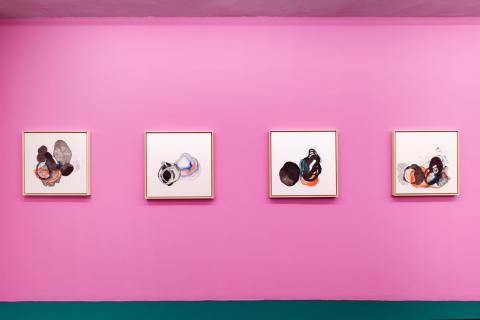
On Bibliophilia and Daily Practice
Since the 1990s, Guillaume Dégé has been devoting himself to keeping notebooks, this daily practice becoming the breeding ground for all his graphic work. In this talk, Dégé presents the typology of his notebook practice, both free and without prerequisites yet also ritualised and formalised. A bibliophile, Dégé details the uses of the notebook as an intimate tool with examples ranging from ‘jogging’ notebooks, which allow him to formulate graphic problems while maintaining his hand’s ability, to ‘compost’ notebooks, where interesting parts of failed drawings are recycled through collage.
-
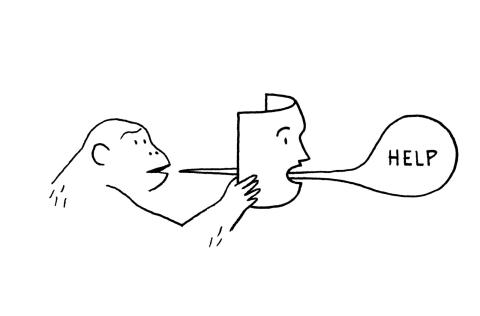
On the Creative Muscle
Pondering on creative thinking, the illustrator Delphine Perret wanted to examine the experiences of her colleagues. Her book Les Ateliers is the result of a meeting with 24 illustrators who told her about their way of stimulating the creative muscle and the conditions under which it can function. The relationship between artistic and non-artistic work, procrastination, the need for a recognition of creative activity as work, the studio as an intimate place of emergence, and creative epiphany: Perret shows, through these encounters with her fellow illustrators, the considerable energy it requires to get to work.
-
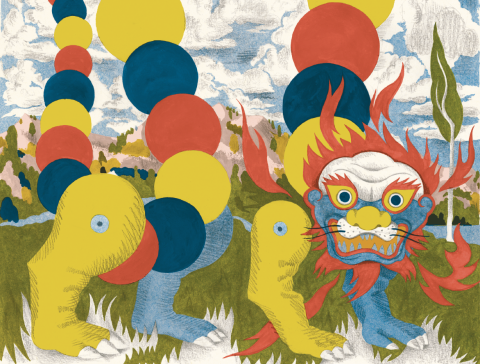
The Book as a Medium
Cover page, binding, reading direction, back cover, the illustrator Blexbolex sees the book as a precise mechanism whose inner workings he uses and disrupts to imagine publications that surprise and amaze by their ingenuity and their ability to create narration. Blexbolex considers his passion for the book as an object, which began in a silk-screen printing workshop, and comments on the variety of his production, from underground productions to thrillers and children's books.
-
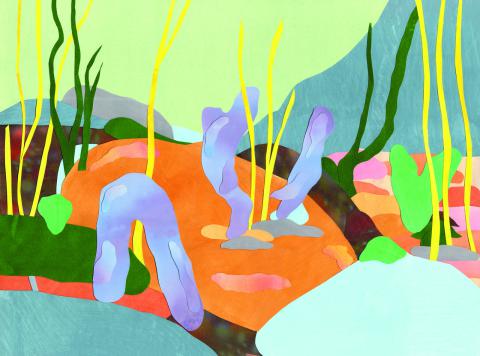
On Process and Serendipity
Averse to intentionality and fixed creative processes, the artist Anne Brugni has set up a working framework where accidents, chance associations, and serendipity can occur. She thus often composes from cut-out papers that end up in a jumble on her desk or on the floor. Certain coincidences of proximity favour the shaping of images. Here, Brugni describes this mode of production made up of controlled uncertainty, where the idea is always next to oblivion, waste to salvage.
-
On Paper Theatre
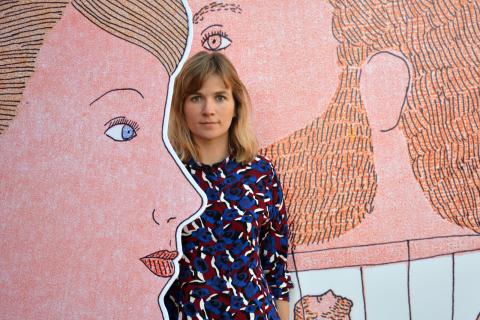
Passionate about theatre and dance, but believing herself to have little talent for these practices, Marion Fayolle has bypassed the limits of the stage by imagining a theatre on paper, where her characters move and dance. Fayolle explains how she treats human figures as archetypes in disguise, tracing and then re-using them as interchangeable actors from one stage and one book to another. Her stories develop as a form of sequence from one drawing which suggests another, showing far greater potential for interaction and transformation than that of actual individuals on stage.
-
On Time and Space Constraints
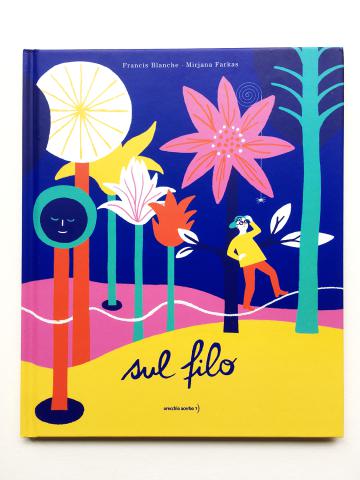
Mirjana Farkas questions the constraints of illustration, grouping them under the broad categories of Time and Space. Time that is gained and lost, dreamt of or successfully spared. The time it takes to create a book and the time given by the commissioner. The space of the imaginary museum in the mind, that of meetings and collaborations. But also the creative activities’ physical space, be it the studio or the medium. Farkas discusses her practice through the prism of these various ways of apprehending the constraints of illustration, which are also opportunities.
-
On the Dissolution of Personal Style
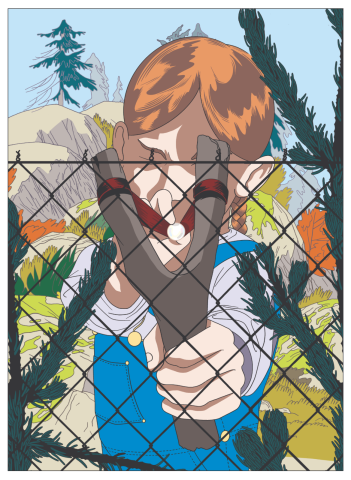
In this talk, Anne-Margot Ramstein discusses the four-handed work that has developed through her collaboration with Matthias Arégui. This joint production of images, which began instrumentally when she needed to show drawings to a publisher, has enabled her to free herself from some of the constraints of what is expected in an album in terms of personal style and signature. Ramstein speaks about how they allow themselves to add to or delete one another's work, without any marked deference to it, in order to create a dual work, and how this activity as part of a pair influences her personal practice.